
Recognises a word only in a list
A familiar character looks unfamiliar inside a passage.
Teaching focus
Revisit meaning through a short context, related phrases and a new sentence the child can explain.
P1–P6 foundations and PSLE preparation. S1–S4 support for G2 and G3, with teaching adapted to your child.
Every learner starts from a different place. We begin by understanding your child's needs, then discuss the level, format and learning support that best fits their next step.
Marymount centre + online options
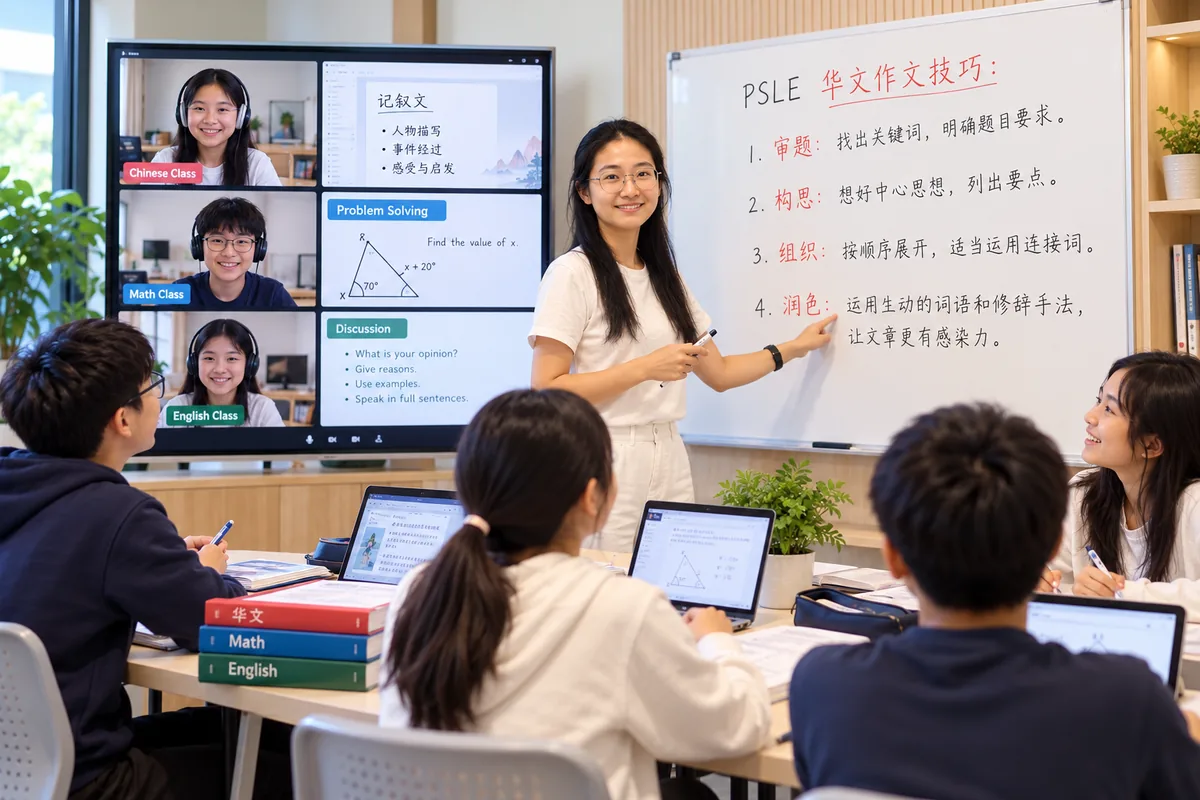
The assessment tables below help you see what your child is working towards. They cover the labelled PSLE, Higher Chinese or SEC G3 paper. For G2 learners, we adjust the teaching and practice to their subject requirements.
Spelling success does not always transfer to comprehension or composition. A learner may recognise a word in a familiar list but lose its meaning in a new sentence. We distinguish recognition gaps, weak sentence understanding and difficulty expressing an idea, rather than treating every lost mark as a need for more memorisation.
| Component | Weight / marks | Format |
|---|---|---|
| Writing | 20% | 50 min; topic or picture composition |
| Language use & comprehension | 45% | 1 h 40 min |
| Oral | 25% | Reading aloud and video-based conversation |
| Listening · Home practice; not taught at SLC | 10% | About 30 min |
Official syllabus references:PSLE Chinese 0005
A familiar character looks unfamiliar inside a passage.
Revisit meaning through a short context, related phrases and a new sentence the child can explain.
The child has located the event but not identified what the question asks.
Separate who, what, why and how; select evidence and shape it into a precise response.
A story becomes a list of actions with little connection between events.
Use oral rehearsal, a simple event sequence and sentence expansion before independent writing.
Talk about a short everyday event in Mandarin. Invite your child to say what happened, why it mattered and how someone felt. This gives written work an accessible starting point.
A secondary learner may know the content of a passage but struggle to organise a written reply, interpret a character’s response or discuss a social issue. We connect language knowledge with the purpose of the task so that learning transfers across writing, reading and spoken interaction.
| Component | Weight / marks | Format |
|---|---|---|
| Writing | 30% | 2 h; email and composition |
| Language use & comprehension | 35% | 1 h 30 min; cloze, word replacement and reading |
| Oral | 25% | Reading aloud and video conversation |
| Listening · Home practice; not taught at SLC | 10% | About 30 min |
Official syllabus references:O-Level Chinese 1160 · SEC G3 Chinese K320
A response sounds polite but leaves a concern or requested action unresolved.
Map each task requirement, identify the reader and organise a complete response in an appropriate register.
A familiar word is used with the wrong partner or tone.
Compare near-synonyms in short passages and explain why one choice works better.
The student recounts an event but does not develop a view.
Connect the example to a reason, consider another perspective and respond to a follow-up question.
Use a short news item as a conversation starter. Ask what the issue is, who is affected and what a sensible response might be. Clarity matters more than forcing difficult idioms into every sentence.
Bring a recent marked assignment, your child’s level and any teacher feedback to the programme discussion. We can use these to identify whether the priority is understanding, expression, application or independent working.
Look for a repeated error pattern and ask the learner to explain a response. One low score alone does not show the cause.
CBC offers structured coaching; BBTP offers targeted practice. Discuss the appropriate subject and components before choosing the combination.
Useful review questions include: can the child explain the method, revise the answer and apply the learning to a fresh task with less prompting?
Try the questions above with your child. Their explanation often tells you more than the final answer and helps us decide what to work on next.
Share the level, subject and areas that need attention.
Our team will advise on support and assessment where appropriate.
Ask us about lesson times, online or Marymount options, and fees.
Start with your child’s stage, subject and learning needs. Our Academic Strategist can discuss a suitable pathway and whether a profile banding assessment would help.
English and Chinese learning can take place at the Marymount centre or online, subject to programme availability. Math is offered online. Please confirm your preferred format with our team.
Class placement and available times depend on your child’s learning needs. Contact our team with your preferred days and times for current availability and fees.
Our Academic Strategist will first discuss your child’s learning with you online, answer your questions and help you choose a suitable class.
Tell us your child's level, subject and learning needs. Our team will guide you.
The same subject changes as a child grows. Choose the school level first, then discuss current work, confidence and the next learning goal.
| Level and subject | Learning priorities |
|---|---|
| Primary 1 (P1) Chinese tuition | Build character recognition, vocabulary in context and confidence using Chinese. |
| Primary 2 (P2) Chinese tuition | Build character recognition, vocabulary in context and confidence using Chinese. |
| Primary 3 (P3) Chinese tuition | Develop reading comprehension, connected writing and clearer spoken responses. |
| Primary 4 (P4) Chinese tuition | Develop reading comprehension, connected writing and clearer spoken responses. |
| Primary 5 (P5) Chinese tuition | Strengthen PSLE comprehension, composition and oral preparation. |
| Primary 6 (P6) Chinese tuition | Strengthen PSLE comprehension, composition and oral preparation. |
| Secondary 1 (S1) Chinese tuition | Read longer texts, explain inferences and develop purposeful written and oral expression. |
| Secondary 2 (S2) Chinese tuition | Read longer texts, explain inferences and develop purposeful written and oral expression. |
| Secondary 3 (S3) Chinese tuition | Refine comprehension and expression against the student’s G2 or G3 SEC subject requirements. |
| Secondary 4 (S4) Chinese tuition | Refine comprehension and expression against the student’s G2 or G3 SEC subject requirements. |
We build skills step by step as your child moves through school. English and Chinese lessons are available at Marymount and online; Math tuition is online. Our team can help you choose a suitable class.
We teach G2 alongside G3, adapting explanations, task difficulty, pacing and feedback to G2 students’ needs. We aim to strengthen confidence at school while building towards the SEC examinations early—not by rushing through harder papers, but by making challenging learning manageable.
Begin with the learner’s actual G2 syllabus, current schoolwork and recurring gaps. Break a task into clear steps and model the reasoning before independent practice.
Use carefully selected G3-level material where it deepens a shared skill. Add prompts, worked examples or vocabulary support; reduce support as understanding becomes more secure.
Look for clearer explanations, fewer repeated errors and more independent responses to new tasks. Prepare progressively for SEC demands while protecting time to consolidate learning.
Chinese: unpack a text’s vocabulary and evidence before asking for a deeper inference; develop an oral viewpoint through a reason and an example rather than memorising a script.
The Singapore-Cambridge Secondary Education Certificate (SEC) replaces the former GCE O-Level and N-Level examinations. G3 follows the former O-Level standard, while G2 follows the former N(A)-Level standard. We teach G2 students alongside G3 with extra guidance, a suitable pace and more challenging practice when they are ready. Lessons build school confidence while preparing each student for their own subject level.
SEAB: G2 English K200, Chinese K220 and Mathematics K210
Many of our students come from the North-East, North and East, travelling to Marymount for English and Chinese classes as well as joining online. We also teach families from central Singapore, the West and Johor Bahru. Math and BBTP classes are online.
Marymount, Bishan, Thomson, Ang Mo Kio, Yio Chu Kang, Toa Payoh, Novena and Serangoon
Hougang, Kovan, Sengkang and Punggol
Many of our English and Chinese students from these estates travel to Marymount for onsite classes, as well as joining online lessons.
Yishun, Sembawang and Woodlands
Many of our English and Chinese students from these estates travel to Marymount for onsite classes, as well as joining online lessons.
Bukit Timah, Bukit Panjang, Choa Chu Kang, Bukit Batok, Jurong East, Jurong West and Clementi
Bedok, Tampines, Simei, Pasir Ris, Marine Parade, Queenstown and Bukit Merah
Many of our English and Chinese students from these estates travel to Marymount for onsite classes, as well as joining online lessons.
Our students come from islandwide Singapore and even Johor Bahru, attending onsite classes in Marymount and joining our online classes. English and Chinese have onsite and online options, subject to programme availability; Math is online only.
Start with programme advice online. Our Academic Strategist can help you choose suitable lessons, whether your child will join online or attend classes at Marymount.
Ask about onsite or online classes →