
Reading and writing in Chinese
Understand meaning in context and explain it precisely, rather than relying on a collection of impressive phrases.
For children preparing for DSA Chinese or Bilingualism. We work on reading, discussing ideas and answering questions in their own words, rather than memorising a script.
Entry to SLC’s class is by a qualifying test.
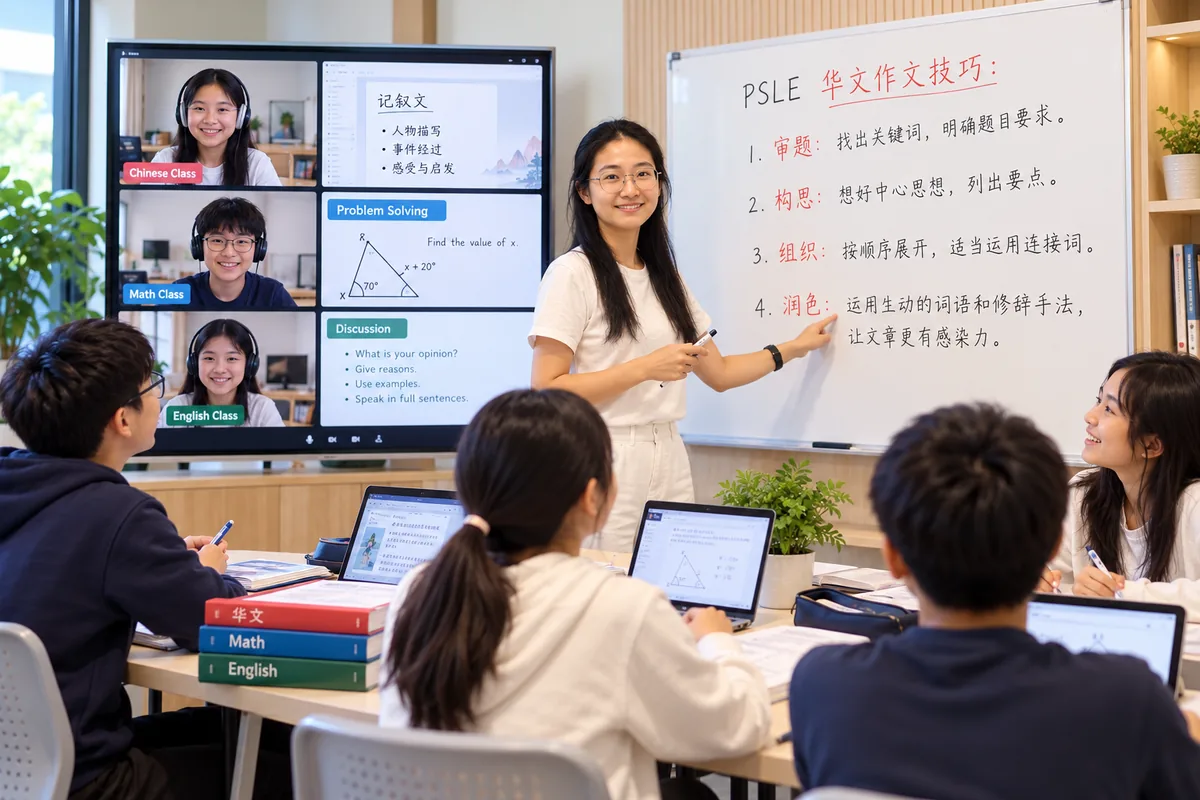
SLC Global Talent Development builds language, thinking and cultural understanding over time, connecting learning with DSA, BSP and CLEP pathways and nurturing confident, capable global scholars.
Tell us about your child’s Chinese and English, their interests and what they hope to prepare for. We’ll discuss the class content and arrangements with you.
We recommend joining both our Chinese DSA Scholars Class and English DSA Scholars Class. The English pathway links to our GEP English Current Affairs Class, helping students build ideas and discuss them clearly in both languages.
Entry to the Chinese DSA Scholars Class is by a qualifying assessment. It may include:
Tell us your child’s level and which DSA area they are interested in. We’ll explain the assessment tasks, how to submit them, the timeframe and any charge before you decide. This is SLC’s class assessment; it is separate from a school’s DSA selection and does not guarantee admission.
Ask about the qualifying assessment →Parents may see excellent Chinese marks and wonder whether DSA Bilingualism is the right route. The next question is how a child uses both languages: to understand an unfamiliar idea, explain a viewpoint, listen thoughtfully and show a genuine interest in culture. Those abilities need room to develop beyond a familiar exam answer.
Understand meaning in context and explain it precisely, rather than relying on a collection of impressive phrases.
Explore different perspectives with curiosity and relevant examples, without reducing cultures to stereotypes.
Express a personal view, respond to a new question and listen to someone else’s contribution.
Explore these DSA language pathways with your child. Look at what each school values, then consider where your child’s interests and strengths fit best.
Each school places a different emphasis on bilingual expression, Chinese language, cultural interest and communication. The cards below explain those differences and how we help students prepare.
 Hwa Chong Institution
Looks for written and spoken strength in English and Chinese, cultural curiosity and engagement across perspectives. Shortlisted applicants attend in-person selection.
Practise explaining a cultural or everyday issue clearly in both languages and developing a reasoned view.
 Nanyang Girls’ High School
Selection tests and interviews are published stages. Upper-secondary DSA Bilingualism students must take Chinese Literature through CLEP.
Develop interpretation and independent expression, while discussing whether sustained literary and cultural study interests the child.
 Catholic High School
The Bilingualism route is listed under IP. It values both languages, meaningful achievement and bicultural interest; shortlisted applicants have a group interview.
Connect genuine experiences to personal learning; practise listening, building on another speaker’s point and contributing without dominating.
 CHIJ St Nicholas Girls’ School
Seeks passion for English and Chinese, understanding of Western and Chinese cultures, critical thinking and oratorical ability in both languages.
Work on a clear viewpoint, relevant examples and flexible spoken expression across the two languages.
 Nan Chiau High School
Lists consistent P5/P6 academic performance and interest in both languages. DSA Bilingualism students must take CLEP-Sec and Chinese Literature in Sec 3.
Show how reading, speaking and cultural participation reflect a continuing interest, and understand the later subject commitment.
 Evergreen Secondary School
Lists Bilingualism alongside separate Chinese and Malay language routes. Detailed selection criteria and instructions should be confirmed directly with the school.
Check whether the school lists Chinese Language, Bilingualism or another category. Each has its own requirements.
 Chung Cheng High School (Main)
Lists Chinese Language as its DSA talent area. Published selection includes an interview and a brief written task. Confirm the current academic and Chinese-language criteria directly with the school.
Develop thoughtful Chinese reading, clear written expression and flexible oral responses, using genuine language and cultural interests. This is a Chinese Language route, not a Bilingualism category.
Parents often come to us with these concerns. We work through them with your child’s strengths, confidence and school goals in mind.
Knowing an answer and explaining a view are different skills.
Start with an unfamiliar short text or image; build a view, a reason and an example, then practise answering a changed question.
Confidence in Mandarin can conceal difficulty expressing the same idea in English, or the reverse.
Review both-language readiness. Use the same idea across languages to expose gaps; discuss additional English support if that is the main need.
School reputation can overshadow the actual route and its later commitments.
Match the child’s interests and current work to the published route. Discuss whether the child would enjoy the school’s language, cultural or literary development after entry.
A certificate list does not explain what the child contributed or learnt.
Select genuine experiences and practise explaining the role, challenge, learning and next question. Preserve the child’s own work and voice.
A polished script can make a student less flexible when the conversation changes.
Practise short discussions, respectful disagreement and follow-up responses, with feedback on reasoning and clarity rather than a fixed script.
More classes do not automatically create more useful progress.
Identify the few priorities with the greatest relevance, review progress and keep national-exam preparation and the child’s capacity in view.
In Chinese DSA Scholars Class, your child reads about an idea, explains their view, answers follow-up questions and learns from feedback. The aim is to help them discuss their own interests and ideas, not rely on a prepared script.
Use SLC’s qualifying test and a discussion of recent work to identify strengths and gaps.
Discuss the verified school route, language balance and the child’s interests before agreeing the focus.
Connect reading, viewpoint development and spoken responses through age-appropriate language and cultural themes.
Look for independent explanations, relevant examples and more flexible responses to a fresh prompt.
Explore a short text about heritage in a changing neighbourhood → compare viewpoints → explain a view in Chinese → summarise the idea in English → discuss a new counter-question → revise one response. Each step gives the child a chance to explain and improve an idea.
“Scholars” is the name of our class. Lessons focus on deeper Chinese learning, bilingual thinking and confident communication for the DSA language pathway.
Read the particular school’s criteria. Bilingualism routes look beyond Chinese marks; the balance of English, Chinese, interest, achievement, potential and selection performance varies by school.
Discuss whether core subject support should come first or sit alongside the class. A stretch pathway works best when its learning demands are appropriate to the child.
Our qualifying test helps us understand your child’s readiness for the class. School DSA applications have their own assessments and interviews.
Recent English and Chinese work, school feedback, the intended application year and any genuine language or cultural experiences. We can then discuss a suitable preparation focus.
Our focus is on helping your child think for themselves, communicate clearly and enjoy using both languages.
Start with strengths, interests and readiness — then build the next step together.
Use the schools’ own information to confirm the talent category, selection criteria and later commitments. Published pages may refer to the latest completed exercise; check the intended application year.
Official-source links compiled 14 November 2026. SLC is an independent learning provider; these links do not imply a school partnership.
Tell us your child’s level, subject, what they find difficult and the days you’re free. We’ll discuss your child’s strengths, learning priorities and a suitable talent-development pathway.
Ask about a suitable class →Opens a WhatsApp draft. Review it and press Send in WhatsApp to reach SLC.