
Knows the words, misses the meaning
An answer repeats a sentence without explaining what it implies.
How we help
Locate evidence, explain the link to the question, then check whether the answer fully responds.
From the 2027 graduating cohort, SEC replaces O-Level and N-Level exams. G3 follows the former GCE O-Level standard; G2 follows N(A)-Level and G1 follows N(T)-Level. Lessons and exam practice follow the subject level your child takes. Source: SEAB.
Help with comprehension, writing and oral, from Primary 1 to Secondary 4. Tell us what your child finds difficult and we’ll discuss a suitable class.
Adjusted to the month’s lesson count: these rates are quoted per 4 lessons. The amount payable each month is adjusted according to the number of lessons that month; confirm the exact fee with our team.
SLC uses a team-based teaching model. A class may have a main teacher and co-teachers.
CBC students receive unlimited access to open consultation (T&Cs apply). Ask our team about eligibility and consultation arrangements before enrolling.
Explore CBC →Tell us what happens when your child does their schoolwork. Do they struggle to understand the question, get started or explain an answer? A recent assignment can help us discuss which class would be useful.
Marymount centre + online options
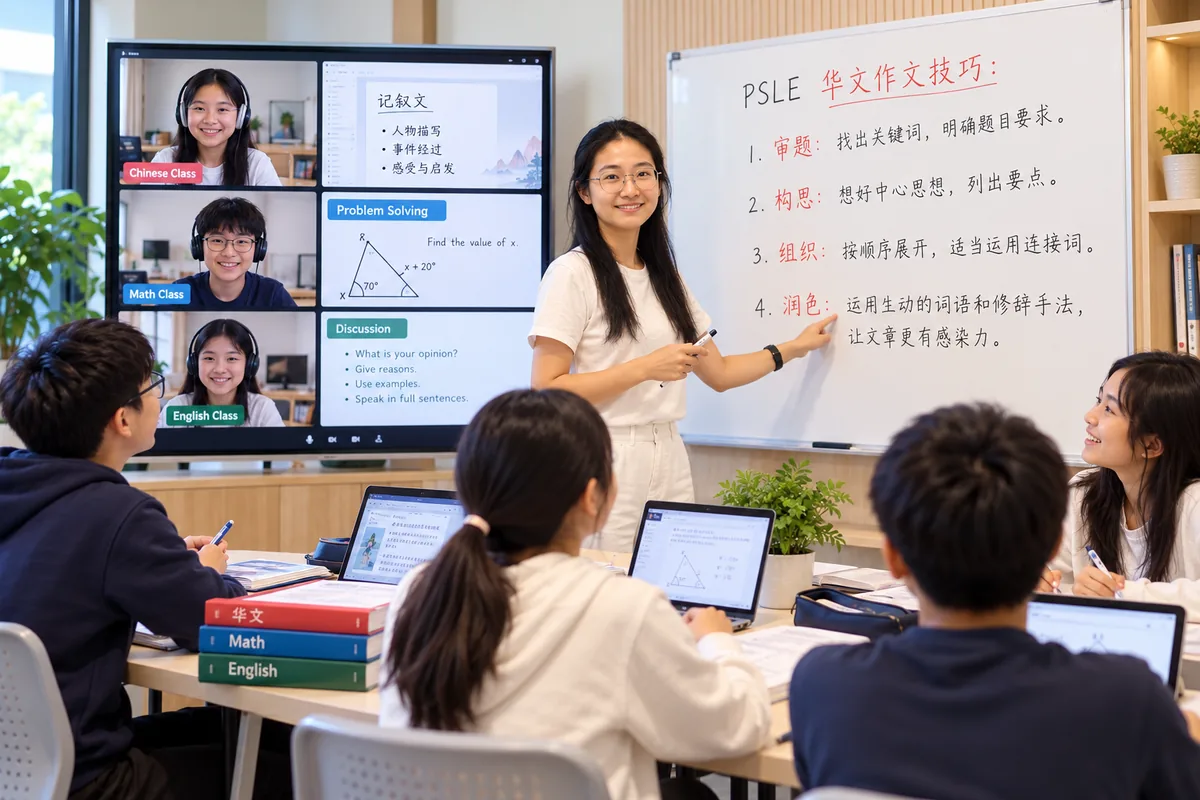
The tables below explain the exam papers and marks. Check the exam name shown: the PSLE, Higher Chinese and SEC G3 papers have different requirements. G2 students practise for their own syllabus.
Speaking English comfortably does not always mean doing well in English exams. Your child may miss the meaning behind a sentence, go off-topic in composition or leave out part of a situational-writing task. We look at their answers to decide what needs practice.
| Component | Weight / marks | Format |
|---|---|---|
| Writing | 25% | 1 h 10 min; situational 14 marks, continuous 36 marks |
| Language use & comprehension | 45% | 1 h 50 min |
| Listening · Home practice; not taught at SLC | 10% | About 35 min |
| Oral communication | 20% | Reading aloud and photo-based conversation |
Official syllabus references:PSLE English 0001
An answer repeats a sentence without explaining what it implies.
Locate evidence, explain the link to the question, then check whether the answer fully responds.
Interesting language cannot rescue a story that drifts away from the topic.
Plan the central event and turning point, then revise for relevance, paragraph flow and sentence accuracy.
A child gives a view but cannot develop it beyond one sentence.
Practise an opinion, a reason and a relevant personal example, followed by a natural response to a follow-up question.
Ask “Which part of the text made you think that?” rather than only checking whether the answer is right. Progress includes clearer explanations and better revisions, not just longer answers.
The move from primary to secondary English asks for more than a larger vocabulary. Students need to explain how language affects a reader, separate a writer’s point from supporting detail and sustain a coherent viewpoint. These demands can expose gaps even in students who previously scored well.
| Component | Weight / marks | Format |
|---|---|---|
| Writing | 35% | 1 h 50 min; editing, situational and continuous writing (composition) |
| Comprehension | 35% | 1 h 50 min; visual, narrative and non-narrative texts; summary |
| Listening · Home practice; not taught at SLC | 10% | About 45 min |
| Oral communication | 20% | Planned video response and spoken interaction |
Official syllabus references:O-Level English 1184 · SEC G3 English K300
Naming a technique does not explain the impression it creates in context.
Work from a precise quotation to its connotations and the reader’s likely understanding.
Your child copies the examples in the passage but misses the main point they are meant to show.
Separate claims from illustrations, group related ideas and practise concise paraphrasing.
An essay states several views without supporting or linking them.
Build a paragraph around a claim, a relevant example and an explanation of why the example matters.
Read a short article together. Ask your child which view they agree with and why. Can they explain their reasons or improve an unclear answer? That matters more than adding impressive words.
Share a recent marked assignment and any comments from the school teacher. We’ll look at where your child gets stuck and discuss what to work on first.
Does the same mistake keep coming up? Ask your child how they got the answer. The score alone may not tell you what went wrong.
CBC is for regular subject teaching. BBTP gives extra practice in a particular skill, such as writing or problem-solving. We can discuss whether your child needs one or both.
Can your child explain the answer, correct a mistake and try a similar question with less help? These are useful things to check alongside school marks.
Ask your child to talk you through an answer. Hearing their explanation can help you see which part they understand and where they need help.
Tell us your child’s level, subject and what they find difficult.
We’ll discuss suitable classes and let you know if an assessment would help.
Check the class time, fees and whether lessons are online or at Marymount.
Tell us your child’s level, subject and what they find difficult. Our team will explain the class options and whether an assessment would help us recommend a class.
English and Chinese learning can take place at the Marymount centre or online, subject to programme availability. Math is offered online. Please confirm your preferred format with our team.
Tell us your child’s level and the days you’re free. We’ll check suitable classes, available times and the fee with you.
We’ll first speak with you online about your child’s schoolwork, answer your questions and discuss a suitable class.
Tell us your child’s level, subject and what they need help with. We’ll talk you through the class options.
Choose your child’s level below to see what we work on. If you’re unsure where to start, share a recent piece of schoolwork with us.
| Level and subject | What we work on |
|---|---|
| Primary 1 (P1) English tuition | Build vocabulary, sentence confidence, reading habits and spoken expression. |
| Primary 2 (P2) English tuition | Build vocabulary, sentence confidence, reading habits and spoken expression. |
| Primary 3 (P3) English tuition | Find clues in the passage, explain answers and organise ideas into clear paragraphs. |
| Primary 4 (P4) English tuition | Find clues in the passage, explain answers and organise ideas into clear paragraphs. |
| Primary 5 (P5) English tuition | Develop PSLE comprehension, composition and oral readiness at an appropriate pace. |
| Primary 6 (P6) English tuition | Develop PSLE comprehension, composition and oral readiness at an appropriate pace. |
| Secondary 1 (S1) English tuition | Bridge primary and secondary texts; strengthen inference, summary and writing for an audience. |
| Secondary 2 (S2) English tuition | Bridge primary and secondary texts; strengthen inference, summary and writing for an audience. |
| Secondary 3 (S3) English tuition | Work on comprehension, writing and oral questions for your child’s G2 or G3 syllabus. |
| Secondary 4 (S4) English tuition | Work on comprehension, writing and oral questions for your child’s G2 or G3 syllabus. |
We build skills step by step as your child moves through school. English and Chinese lessons are available at Marymount and online; Math tuition is online. Our team can help you choose a suitable class.
G2 students can learn alongside G3 students. We start with your child’s G2 schoolwork and give help where they need it. When they are ready, we may try a harder question together. Exam practice still follows the subject level your child takes.
Look at a recent assignment or paper together.
Use an example to make the meaning or method clear.
Your child has a go, with prompts where needed.
Check whether they can answer with less help.
Read the question → Find a clue → Explain what it means → Check the answer addresses the question
Many of our students come from the North-East, North and East, travelling to Marymount for English and Chinese classes as well as joining online. We also teach families from central Singapore, the West and Johor Bahru. Math and BBTP classes are online.
Marymount, Bishan, Thomson, Ang Mo Kio, Yio Chu Kang, Toa Payoh, Novena and Serangoon
Hougang, Kovan, Sengkang and Punggol
Many of our English and Chinese students from these estates travel to Marymount for onsite classes, as well as joining online lessons.
Yishun, Sembawang and Woodlands
Many of our English and Chinese students from these estates travel to Marymount for onsite classes, as well as joining online lessons.
Bukit Timah, Bukit Panjang, Choa Chu Kang, Bukit Batok, Jurong East, Jurong West and Clementi
Bedok, Tampines, Simei, Pasir Ris, Marine Parade, Queenstown and Bukit Merah
Many of our English and Chinese students from these estates travel to Marymount for onsite classes, as well as joining online lessons.
Our students come from islandwide Singapore and even Johor Bahru, attending onsite classes in Marymount and joining our online classes. English and Chinese have onsite and online options, subject to programme availability; Math is online only.
Start with programme advice online. Our Academic Strategist can help you choose suitable lessons, whether your child will join online or attend classes at Marymount.
Ask about onsite or online classes →We teach IP English from Year 1 to Year 4. Papers differ from school to school. Send us a recent paper and the school’s instructions so we can check the format and discuss whether our IP English support would suit your child.
We teach IP English, rather than the full Language Arts course. If your child takes Language Arts, they can join GEP English Current Affairs to practise reading, discussing issues and explaining their views. These skills are relevant to their syllabus too.