
G3 Sec 1 · Number and algebra
Use primes, factors and signed numbers accurately. Make sense of ratio, percentage and speed, then connect expressions and linear equations to straight-line graphs.
SECONDARY 1–2 · G3 & G2 · ONLINE
We help Sec 1–2 learners turn arithmetic reasoning into algebraic models and justify geometric steps. Students learn to form the relationship, choose a method and explain their working.
Live online Math lessons · Learn from home across Singapore
FROM OUR MATH TEACHING EXPERIENCE
Our secondary Math teaching experience includes helping students improve from F9 to A1 within 3–6 months. For G2 and IP learners, we work with the school’s grading system and the child’s own targets.
The Sec 1–2 topic map moves from number sense to algebra, graphs and geometric reasoning. We follow the child’s G2 or G3 school sequence and choose a useful starting point.
Use primes, factors and signed numbers accurately. Make sense of ratio, percentage and speed, then connect expressions and linear equations to straight-line graphs.
Reason with angles and polygons, measure composite shapes and solids, and read tables and graphs with care. Explain the choice of method as well as the answer.
Extend algebra through expansion, factorisation, fractions and changing the subject of a formula. Connect simultaneous equations and quadratic graphs, and interpret direct or inverse proportion.
Apply similarity, Pythagoras and right-angled trigonometry. Work with solids, averages and simple probability while keeping diagrams, units and explanations clear.
A CURRICULUM WITH A CLEAR STRUCTURE
Open a chapter group to see the learning focus and a short recap prompt. Earlier ideas return in later work, so the next topic has a stronger base. The year map follows G3; G2 topic timing is shown in the subject-level comparison below. Lessons follow the student’s subject level and school sequence.
Use prime factorisation, HCF and LCM to organise number relationships.
Quick recap: Is the question asking for a shared factor or a shared multiple?
Calculate with signed numbers, order values and use rounding and significant figures meaningfully.
Quick recap: Check the sign and the expected size of the answer.
Interpret comparisons, reverse percentages and compound units in everyday situations.
Quick recap: Name the starting quantity and keep units consistent.
Translate words into algebra, simplify, form equations and express a pattern using a general term.
Quick recap: Substitute the solution back into the original equation.
Connect coordinates, intercept and gradient to a relationship between two quantities.
Quick recap: Explain the gradient with the quantities and their units.
Use angle facts, shapes, area and the surface area or volume of appropriate solids.
Quick recap: Which lengths are needed before using the formula?
Read scales and compare representations, including recognising a misleading display.
Quick recap: Does the graph’s scale change the impression it gives?
Connect direct and inverse proportion with scale drawings and quantities.
Quick recap: Which product or ratio stays constant?
Expand, factorise, change the subject of a formula and operate on algebraic fractions.
Quick recap: Factorise before deciding what can be cancelled.
Solve simultaneous equations and factorisable quadratics; connect roots to quadratic graphs and inequalities to a number line.
Quick recap: Check each root in the original equation.
Match corresponding sides and angles before using a proportion.
Quick recap: Write the matching order before forming a ratio.
Identify the hypotenuse and choose a useful ratio for an acute angle.
Quick recap: Label opposite and adjacent for the chosen angle.
Work with pyramids, cones and spheres, and distinguish surface area from volume.
Quick recap: Are the required units squared or cubed?
Interpret diagrams, use mean, median and mode, and list outcomes to calculate a simple probability.
Quick recap: What is the complete set of possible outcomes?
Both G2 and G3 learners practise understanding, method selection and explanation. We adjust prerequisites, scaffolding, pace and question complexity to the student’s subject requirements and demonstrated readiness.
Make sense of the quantities, representations and conditions.
Compare possible methods and decide which fits.
Justify key steps and check the conclusion in context.
Topic timing differs; understanding and reasoning matter at both levels. This comparison follows MOE’s content-by-level tables. The chapter map follows G3.
| Topic / scope | G3 | G2 |
|---|---|---|
| Straight-line graphs and gradients | Sec 1 | Sec 2 |
| Quadratic graphs and equations | Sec 2 | Sec 3–4 |
| Right-angled trigonometry | Sec 2 | Sec 3–4 |
All year levels below refer to 2027.
Settle into algebra and mathematical language. Learn to label a diagram, form an equation and explain what the answer means.
Build similarity, Pythagoras, statistics and algebra skills. G3 also includes quadratic equations and right-angled trigonometry at this stage; G2 develops these in upper secondary.
SLC WORKED EXAMPLES
From a price flow to similar triangles, see how the first useful step changes the problem.
G3 SEC 1 / G2 SEC 2 · PERCENTAGES & ALGEBRA
In a hypothetical town with an 8% sales tax, two shops sell the same type of backpack. The stated tax is part of this model, not a claim about Singapore’s current GST rate.
At Shop A, the marked price is unknown. A customer receives 15% off the marked price, then uses a $7 voucher. Sales tax of 8% is added to the reduced price after the voucher. The final receipt total is $120.96.
At Shop B, the backpack has a marked price of $160. Shop B gives 12% off, then adds the same 8% sales tax.
Apply each change to the current price, in the stated order.
Let be the marked price at Shop A, in dollars.
A 15% discount leaves 85%:
After the $7 voucher:
Adding 8% sales tax multiplies this current amount by . The receipt therefore gives the linear equation:
Divide by :
Add 7:
Divide by :
So the Shop A marked price is $140.00.
A 12% discount leaves 88% of $160:
The 8% tax is applied to $140.80:
Rounded to the nearest cent, the Shop B receipt is $152.06.
Shop A is cheaper. The saving is:
The question specifies Shop B’s receipt as the base, so:
To 1 decimal place, the Shop A receipt is 20.5% below Shop B’s receipt.
Answer: Shop A is cheaper by $31.10 when the receipts are rounded to cents, which is 20.5% of the Shop B receipt.
Substitute into the original ordered model: . Both receipt totals are positive, and the comparison denominator $152.064 is non-zero.
A third retailer marks the backpack at $170, gives a 25% discount, then applies an 8% tax. Its receipt is compared with Shop A’s $120.96 receipt. Find the third retailer’s receipt and state the percentage by which Shop A is cheaper, using the third retailer’s receipt as the base. (Calculator permitted; round money to the nearest cent and the percentage to 1 decimal place.)
The third receipt is . Saving relative to that receipt is , so Shop A is cheaper by 12.2%. This transfers the same ordered-multiplier model while changing both the discount and the comparison base.
SEC 2 · G2/G3 · SIMILARITY & PYTHAGORAS
In the diagram, ABC is a right-angled triangle with ∠ACB = 90°. D lies on AB, and CD ⟂ AB. The lengths are AD = 36 cm and DB = 64 cm.
(a) Explain why the two smaller triangles formed by CD are similar, and state the corresponding order of their vertices.
(b) Use the similarity to find CD.
(c) Use Pythagoras to find AC.
(d) Find BC, giving your answer in centimetres.
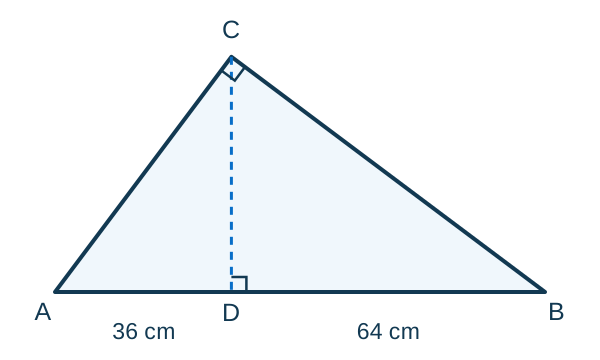
ACD ~ CBD: corresponding right triangles.
(a) Both △ACD and △CBD have a right angle because CD ⟂ AB: ∠ADC = ∠CDB = 90°. Also, ∠CAD and ∠BCD are each complementary to the corresponding acute angle of the large right triangle ABC, so ∠CAD = ∠BCD. Therefore, by AA similarity,
△ACD ∼ △CBD.
The correspondence is A ↔ C, C ↔ B, D ↔ D.
(b) Under that correspondence, corresponding sides first give the explicit proportion
AD / CD = CD / DB.
Therefore the altitude relationships give the geometric-mean result for the segment CD:
CD² = AD × DB
CD² = 36 × 64 = 2304
CD = 48 cm, since a length is positive.
(c) In right triangle ACD,
AC² = AD² + CD²
AC² = 36² + 48²
AC² = 1296 + 2304 = 3600
AC = 60 cm.
(d) First find the hypotenuse of the large triangle:
AB = AD + DB = 36 + 64 = 100 cm.
In right triangle ABC,
BC² = AB² − AC²
BC² = 100² − 60²
BC² = 10000 − 3600 = 6400
BC = 80 cm.
The positive root is selected because BC is a length. The answers are therefore:
△ACD ∼ △CBD, with A ↔ C, C ↔ B, D ↔ D.CD = 48 cm.AC = 60 cm.BC = 80 cm.60² + 80² = 3600 + 6400 = 10000 = 100², so AC, BC, and AB satisfy Pythagoras in the large right triangle. Also, 36:48:60 and 48:64:80 are both scaled 3:4:5 right triangles, consistent with the similarity.
A right triangle PQR has ∠Q = 90°. The altitude from Q meets hypotenuse PR at S, with PS = 9 cm and SR = 16 cm. Without using trigonometry, find QS, PQ, and QR. State the two similar smaller triangles in corresponding order and justify your correspondence.
QS² = PS × SR = 144, so QS = 12 cm. PR = 25 cm; then PQ² = PS × PR = 225, so PQ = 15 cm, and QR² = SR × PR = 400, so QR = 20 cm. A valid correspondence is △PQS ∼ △QRS (P ↔ Q, Q ↔ R, S ↔ S), justified by the right angles and the acute angles inherited from △PQR.
Two students with the same mark may need very different support. Tell us what happens when your child works independently.
Locate the line where the reasoning changes, then practise that skill in a short sequence before returning to the full question.
Label what each number means. Use a diagram, variable or table to organise the information.
Build fluency with focused practice, then use mixed questions to improve method selection and checking.
RESEARCH-INFORMED LEARNING
Short recaps bring earlier ideas back, so your child can use them again in a new question.
Connect a diagram, the method and the reason behind it.
Try a short question from memory, then check the key idea.
Bring an earlier skill back alongside current school topics.
Choose a method, repair an error and solve a fresh version.
Key concepts return over several lessons and practice sets, with short recaps that keep earlier learning active.
Students recall a rule, explain a step or attempt a question before checking notes. This also helps locate the gap that needs attention.
A clear model leads to a partly completed question, then an independent solution as understanding becomes more secure.
Once a method is understood, mix familiar question types so students practise deciding which approach fits.
Identify the step that went wrong, correct the reasoning and return to a related question later.
Connect a calculation to a model or graph and explain why the step works.
SLC’s existing BBTP and CBC pathways give us two ways to approach the next learning goal.
Topic-by-topic work on understanding a question, choosing a strategy and solving it independently. Useful when your child needs a clearer way to begin.
Explore BBTP →Timed drills, mixed-topic practice and review of more demanding questions. Useful when your child needs to apply learning more consistently in an assessment.
Explore CBC →Discuss how topical work and exam practice can fit together around your child’s current needs.
Choose the subject and stage that fit your child.
This page focuses on Sec 1–2 foundations. Our E Math page focuses on Sec 3–4 and SEC Mathematics preparation. Both pathways help students connect concepts, show working and solve independently.
Yes. Share the child’s subject level and current topics. We adapt explanations, pace and practice to their schoolwork and learning needs.
Yes. Tell us which step feels difficult: forming an expression, solving an equation, reading a graph or choosing a method. This gives us a practical starting point.
Yes. All SLC Math lessons are online. Choose a year level and subject on this page to prepare a short WhatsApp enquiry.
Choose the year and learning focus, then add context in WhatsApp.
When you message us, share your child’s recent exam results and any teacher feedback, if available.
We use the year, subject and learning context to discuss a suitable starting point and whether topical teaching, exam practice or a combination would be more useful.
Find the subject that matches your child’s school journey.
Learning focus: lower-secondary algebra, graphs, geometry and data. Lessons follow your child’s G2 or G3 school topics. Reviewed 12 November 2026.
Sources checked 12 November 2026: MOE G2/G3 Mathematics: content by level