
Find the story’s focus
Choose an event that answers the topic. Decide what the character wants, what goes wrong and what changes.
Help your child turn an idea into a story they can plan, write and improve. Guided online writing practice for Primary 3–6 learners.
WhatsApp our Academic Strategist →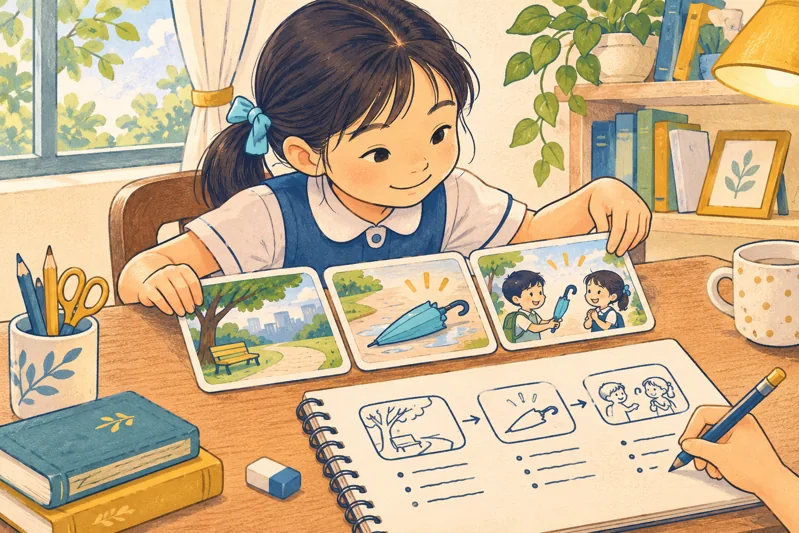
Some children can tell a lively story aloud, then struggle to put it on paper. Others write long compositions with good phrases, but the story feels rushed or moves away from the topic. We teach the decisions behind a clear, engaging story.
Choose an event that answers the topic. Decide what the character wants, what goes wrong and what changes.
Use action, dialogue and carefully chosen details to show a character’s feelings. Learn which moments need more space.
Build a beginning, problem, turning point and ending. This is plot development and paragraph cohesion: the story should move in a clear order.
Improve grammar, sentence control and word choice in the child’s own draft. Language should help the reader understand the story.
Here is a short SLC teaching example. We ask what the detail tells us about the character, then let the child develop the next moment.
Amir was nervous about speaking.
Amir folded the corner of his notes as the room fell quiet. He spotted a familiar face, took a breath and began with the one point he knew well.
The actions show his feelings and a small change in confidence. Your child then writes a different version and explains their choices.
These are skills in characterisation, descriptive detail and narrative development. We explain the terms through examples children can use.
Use a picture or topic to find a relevant event and an interesting problem.
Practise an opening, a key scene or a complete story, based on readiness.
Find what the reader can follow and where an idea needs more detail or clearer language.
Revise the draft, then apply the skill to another prompt.
A correction becomes useful when your child can use it in the next piece of writing.
For PSLE English, a story needs to stay relevant to the topic and the chosen picture stimulus. We help P5–P6 writers plan independently, develop the central event and revise for content and language.
P3–P4 learners can start with sentences and short scenes before moving towards longer stories. The lesson follows the writing your child can manage today.
If your child enjoys sharing ideas about the world, explore English DSA Scholars and English Current Affairs. Those pathways develop reading, reasoning, discussion and presentation alongside written expression.
Our online Creative Writing pathway supports P3–P6 learners. We use shorter guided tasks for developing writers and more independent planning and revision as children become ready.
We discuss examples to show how a story works. Your child then plans, writes and revises their own response, so they learn how to apply the skill to a new topic.
Creative Writing focuses on writing. Our Primary and Secondary English programmes provide broader subject support. The Academic Strategist can help you choose the right combination.
WhatsApp our Academic Strategist your child’s level, school and writing difficulties. A recent piece of writing helps us recommend a starting point and share suitable class arrangements.
Tell our Academic Strategist your child’s level and what happens when they try to write. We’ll help you choose suitable writing support and share the class times and fees.
WhatsApp our Academic Strategist →