Communication and Humanities ask for different strengths
Clear English matters in both. Communication places more emphasis on expressive spoken performance. Humanities also calls for curiosity, reading, research and thoughtful discussion of people, society and the world.
 Raffles Institution (RI)
DSA Communication
Build expressive English communication, confident spoken delivery and the ability to make an idea connect with an audience. RI describes this area through English verbal-linguistic ability and spoken and embodied expression.
 Hwa Chong Institution (HCI)
DSA Humanities
Develop curiosity about history, geography and current affairs. Practise asking questions, connecting ideas and discussing an issue with depth.
 ACS (Independent)
DSA Humanities
Strengthen thoughtful discussion and the ability to explain a humanities interest or piece of work. Our practice helps children organise ideas and respond to follow-up questions.
 Catholic High School (CHS)
DSA Humanities · IP
Explore current affairs, society and environmental issues. Develop reading, writing, research and discussion skills, and work the child can explain in their own words.
English Current Affairs: ideas your child can explain
A child may know a headline but struggle when asked, “Why does it matter?” Our English Current Affairs Class helps students read beyond the headline, consider different views and explain an opinion with a relevant example.
01Read
Understand the issue and the key vocabulary.
02Think
Separate a fact, an opinion and a claim that needs evidence.
03Discuss
Give a reasoned view and listen to another perspective.
04Present
Organise a spoken or written response and improve it with feedback.
Explore the English Current Affairs Class →
Preparing for DSA Bilingualism? Develop both languages.
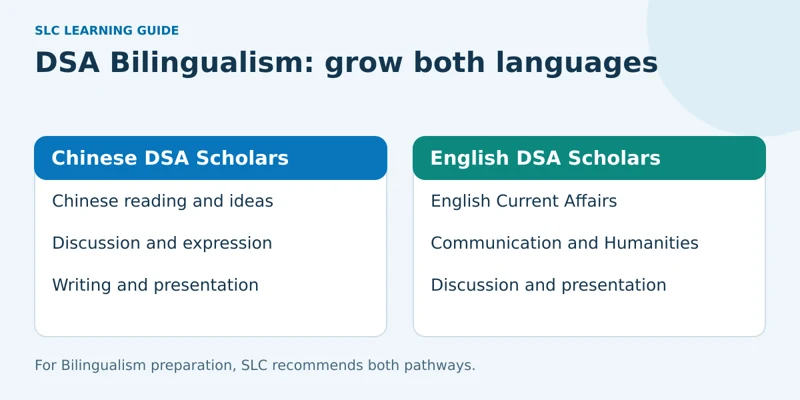
We recommend joining both our Chinese DSA Scholars Class and English DSA Scholars Class. The English pathway links to our English Current Affairs Class.
Students need ideas they can explain clearly in English and Chinese. We help them build understanding, useful vocabulary and the confidence to discuss a topic in both languages.
The aim is to think and respond naturally, rather than translate a memorised script word for word.
What your child will practise
Read and question
Identify a writer’s point, pick out evidence and ask what else would help explain the issue.
Build a viewpoint
Use a clear point, a reason, an example and an explanation of why it matters.
Speak to an audience
Practise structure, pace, voice and purposeful expression. Respond to follow-up questions without losing the main point.
Reflect on real work
Develop reading reflections, short presentations and inquiry tasks. Students explain what they learned and how their thinking changed.
Tell us your child’s current level, interests and any work they are proud of. We’ll use that to choose a suitable starting point.
A question that opens up a discussion
Should schools reduce food waste?
Start with what is happening. Who is affected? What could students, families and the school each do? Which suggestion would work, and what would make it difficult?
Your child then gives a short response with a reason and example. We ask a follow-up question so they practise thinking as they speak.
Looking for story-writing support instead? Explore English Creative Writing →
Parents often ask
Which DSA talent areas does the English pathway support?
We develop English communication, critical reading, humanities discussion, writing and presentation skills relevant to RI Communication and Humanities pathways at HCI, ACS(I) and Catholic High.
How is English Current Affairs linked to English DSA Scholars?
English Current Affairs builds the reading, issue knowledge, reasoning and expression used in the English DSA Scholars pathway. Students practise explaining a view with evidence and responding to questions.
What should a student preparing for DSA Bilingualism join?
We recommend both the Chinese DSA Scholars Class and the English DSA Scholars Class. The English pathway links to English Current Affairs, helping the student discuss ideas clearly in both languages.
Does my child need a portfolio before speaking to SLC?
You can begin with recent writing, a presentation, a reading reflection or a project the child can explain. Our Academic Strategist will help identify the next skills to develop.
Find the right starting point for your child
Share your child’s level, interests and intended DSA talent area. Our Academic Strategist will help you plan the English pathway, or a combined English and Chinese pathway for Bilingualism.
WhatsApp our Academic Strategist →