
Can a Toa Payoh family learn with SLC?
Yes. SLC offers online PSLE Chinese lessons for Toa Payoh families and onsite classes at Marymount. Choose support for vocabulary and comprehension, 3-in-1 Oral & Writing, Higher Chinese or the separate Chinese DSA Scholars pathway. Our Academic Strategist can help you identify the starting point.
Use vocabulary across the whole paper
For Toa Payoh families, we connect the concern to a skill: understanding a word, using it in a sentence, explaining it aloud and developing it in a story. That gives vocabulary practice a clear purpose.
School teaching experience. A team behind the curriculum.
Our former MOE educators bring school teaching experience to the way we explain questions, guide practice and review students’ work.
Chinese curriculum support includes Mrs Tay (郑太太), a retired Senior Teacher with around 40 years of teaching and teacher-development experience. She taught at Chinese High School (now Hwa Chong Institution), Catholic High School and Maris Stella High School. At SLC, she supports the review of Chinese teaching materials and curriculum quality.
Meet our academic advisors →Different schools. Different starting points.
Our students include children from Ai Tong School, Catholic High School and CHIJ St. Nicholas Girls’ School. We look at each child’s work rather than assume that a school name or an AL score tells the whole story.
We have also taught children from Chinese, Indian, Filipino and Korean families, including homes where Mandarin is rarely spoken. Clear explanations and guided practice help children build the language step by step.
See how our teaching team works →Chinese tuition options for Toa Payoh families
Local choices include programmes around Toa Payoh Central and SAFRA Toa Payoh. SLC’s nearby onsite option is at Marymount, with online Chinese lessons also available. Compare the learning focus and the whole weekly routine before choosing.
| Provider | Location / access | Published learning options | Useful comparison point |
|---|---|---|---|
| SLC | Online from Toa Payoh; onsite at Marymount | Core Banded Classes, 3-in-1 Oral & Writing, Higher Chinese and a separate DSA Chinese Scholars pathway. | Share recent work with an Academic Strategist to discuss the starting point. |
| EduFirst Learning Centre | Toa Payoh Central Community Club | Primary Chinese alongside other school subjects. | Ask how vocabulary, reading and written work are reviewed. |
| Berries | SAFRA Toa Payoh | Chinese programmes from preschool through primary school. | Compare the relevant primary class and the amount of guided speaking and writing practice. |
Local centre locations and programme descriptions were checked against their official pages in November 2026. SLC publishes this guide and is included in the comparison.
When choosing a class, compare the actual timetable, lesson length, fees and marked-work feedback. A branch location alone does not tell you which class will fit your child.
Local Toa Payoh class, nearby Marymount or online?
A familiar local centre may fit well around school and family errands. A Marymount class may offer the particular teaching focus your child needs. Compare both with the option of learning from home if the weekly journey takes too much out of the day.
Local
Compare the Toa Payoh classroom, pace and lesson focus. A convenient location is valuable when the child can follow the teaching.
Marymount
SLC’s onsite classes are at Marymount. Ask which class works on the child’s main gap.
Online
Keep the teaching focus while removing the journey. Prepare a quiet place where the child can speak, write and ask questions.
A recent paper or composition helps make the discussion concrete. Look for repeated patterns: unfamiliar words, incomplete answers, weak story development or very short spoken replies.
One word can support several exam skills
Vocabulary work becomes more useful when a child can apply it. Recognising 主动 in an MCQ is one step. Using it in a clear sentence, an oral example or a story gives the word more purpose.
- Recognise: read the word and understand the meaning.
- Build: use it in a sentence that shows a specific action.
- Speak: explain the action and why it helps.
- Write: use the idea in a relevant paragraph.
Our Core Banded Classes build this language foundation. The 3-in-1 Oral & Writing class gives more guided practice with themes, keywords and developed responses. Children with different gaps may need a different balance of the two.
For parents who mainly speak English or another language, ask the child to share one new sentence or explain one correction. You can encourage the routine without having to teach Chinese yourself.
Compare what happens in the lesson
| What to compare | Onsite Chinese tuition | Online Chinese coaching |
|---|---|---|
| Participation | Does your child answer, ask questions and get to speak? | Does your child respond actively, rather than only watch? |
| Written work | How are mistakes explained and corrections reviewed? | How is the child’s own work shared, marked and discussed? |
| Weekly routine | Allow for travel, meals, pickup and follow-up practice. | Prepare the device, a quiet space and writing materials. |
| Progress | Look for clearer answers and independent use of corrections. | Look for the same learning signs, including spoken and written responses. |
The setting supports the learning. It does not replace a clear explanation, suitable practice or feedback the child understands.
Three Chinese pathways, with different teaching priorities
For Toa Payoh families, we choose the teaching focus from the child’s current work. Standard Chinese, Higher Chinese and DSA development have different priorities; within Standard Chinese, vocabulary and oral/writing support address different gaps.
Core Banded Classes: understand the word, then use it
Recognising a word in a spelling list is different from understanding it in a new sentence. In our Core Banded Classes (CBC), students revise PSLE vocabulary, practise word use and build sentences (造句). We connect that work to comprehension, composition and spoken sentence-building (口头造句).
- Understand
识词Know the meaning and the situation. - Build a sentence
造句Show who did what, with a clear idea. - Say it
口头表达Give a reason or a useful example. - Develop it
作文Use the idea in a relevant paragraph.
For comprehension, we teach the child to understand the question, choose relevant evidence and include the detail needed in the answer. Completing more papers helps when the child can also explain and use the corrections.
3-in-1 Oral & Writing: speak it, develop it, write it
When a child mainly speaks English, they may have an opinion but lack the Chinese words to explain it. Our 3-in-1 class combines oral practice, PSLE-related themes and keywords, and composition work.
- Oral practice 口语练习: answer the question, explain a reason and add a relevant experience.
- Themes and keywords 主题与关键词: build useful language around helping others, responsibility and shared spaces.
- Composition 作文: choose events, connect sentences and develop the key moment.
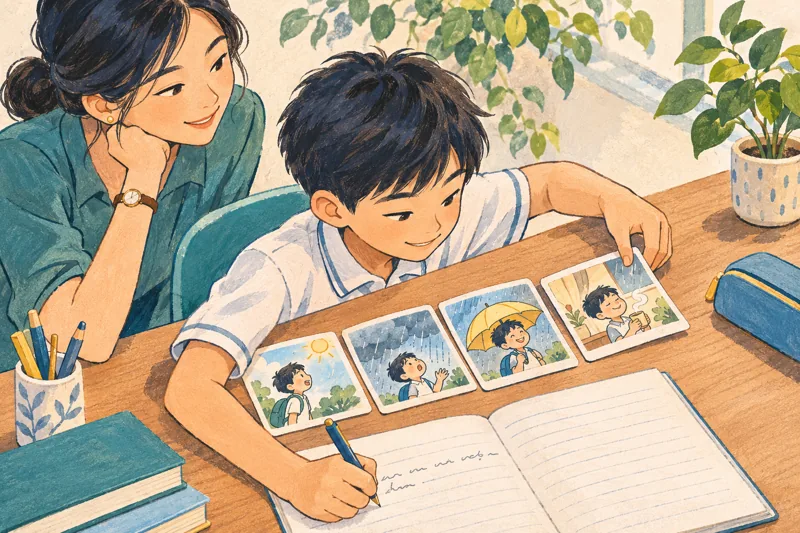
Standard Chinese writing practice covers 看图作文 Picture Composition and 命题作文 Topic-based Composition. Students learn how to develop a connected story, rather than place memorised phrases into every topic.
Higher Chinese: develop the story and explain the meaning
For 完成文章 Continuous Composition, we teach students to follow the given opening, maintain a consistent story and build an ending that fits. 命题作文 Topic-based Composition requires relevant events and a clear response to the topic. We also use 情境作文 Scenario-based Composition practice to develop purposeful narratives around school tasks.
Higher Chinese support includes vocabulary application, precise word choice and deeper comprehension. PSLE Higher Chinese has writing and comprehension papers; a Higher Chinese student still prepares for oral in their Standard Chinese examination.
Explore Higher Chinese support →
DSA Chinese Language & Bilingualism: a separate development pathway
For a child who enjoys reading, discussing ideas and using language beyond school exercises, our Chinese DSA Scholars Class develops language depth, bilingual expression, critical thinking and interview readiness. Students practise a viewpoint, supporting reasons and responses to follow-up questions.
Entry to SLC’s DSA class is by a qualifying test. We discuss the child’s genuine language interests and the relevant school pathways with parents.
Discuss my child’s learning priority →Preparing for DSA Bilingualism? Develop both languages.
We recommend joining both our Chinese DSA Scholars Class and English DSA Scholars Class. The English pathway links to our English Current Affairs Class, helping students build ideas and discuss them clearly in both languages.
See the kind of progress to look for
主动 · Taking initiative
我要主动帮助别人。
A MORE DEVELOPED RESPONSE看到老师正在搬书,我主动上前帮忙,把书分成小叠,和同学一起搬到课室。
The second sentence gives a clear scene and action. That makes the vocabulary useful for an oral example or a composition paragraph.
Teacher’s focus
Give 主动 a specific action and context.
The child’s next attempt
Describe a different act of initiative, then use it in a short oral answer.
Bring these questions to your shortlist
- What should my child work on first? Use recent schoolwork so the answer is specific.
- How will the class teach that skill? Ask about the tasks, explanations and the pace.
- What will my child do after a correction? Look for a chance to apply it in a new task.
- What is the full weekly commitment? Compare lesson time, homework, fees and the travel or device setup.
A useful learning goal is observable: a complete comprehension answer, a clearer story sequence or an oral reply with a reason and example. Review that goal alongside school results.
Students we teach from Toa Payoh and nearby schools
We teach students from primary schools in Toa Payoh and the nearby Marymount, Woodleigh and Potong Pasir school communities. Parents can compare Marymount classes with online lessons to find a routine that works.


Toa Payoh
- CHIJ Primary (Toa Payoh)
- First Toa Payoh Primary School
- Kheng Cheng School
- Pei Chun Public School
Marymount
- Marymount Convent School
Woodleigh & Potong Pasir
- Cedar Primary School
- Maris Stella High School (Primary)
- St. Andrew’s Junior School
Parent and student feedback on the teaching
Parents and students have shared how SLC helped with vocabulary, sentence structure and confidence. The excerpts below keep their original words.
Afreen Niyas
Google review“SLC has helped me improve my Chinese vocabulary and do better for my Paper 2.”
Excerpt · original words
Yi Huey Buan
Google review“His chinese compo has improved in sentence structure which has pulled up his overall marks.”
Excerpt · original words
Read the original parent messages and more student stories →
Questions Toa Payoh parents ask
Is Marymount an option for families looking in Toa Payoh?
Yes. Toa Payoh families can compare local centres with SLC’s classes at Marymount, near Marymount MRT Exit B. Consider the actual lesson time and the child’s learning needs.
Should my child focus on vocabulary or oral and writing?
Look at recent work. If word meaning and sentence understanding are weak, build those foundations. If the child knows the words but gives short or unclear responses, more guided oral and writing practice may help.
Can my child take SLC Chinese lessons online?
Yes. Speak with our Academic Strategist about your child’s level, learning gaps and preferred days to explore the online class options.
How much do SLC’s Chinese classes cost?
WhatsApp our Academic Strategist with your child’s level and main learning need. We will share the suitable class options, lesson format, timings and fees.
Find the right starting point for your child
Tell our Academic Strategist your child’s level, the Chinese work they find hard and whether you prefer online or Marymount lessons. We’ll help you compare the next steps.
WhatsApp our Academic Strategist →