
Understand the issue
Read an age-appropriate text about society, technology, the environment or world events. Build the vocabulary needed to explain it.
Help your child understand what is happening in the world, form a thoughtful view and explain it clearly in English. Reading, discussion and response practice for DSA preparation and secondary English development.
WhatsApp our Academic Strategist →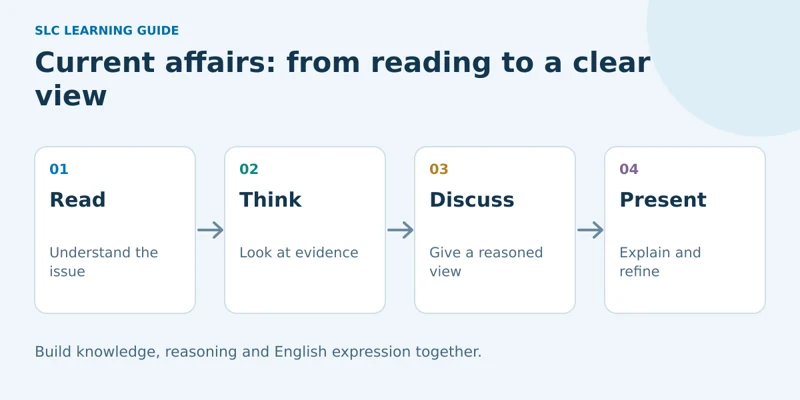
Knowing facts is a starting point. Your child also needs to understand why an issue matters, notice different viewpoints and choose a useful example. We teach the language and the thinking together.
Read an age-appropriate text about society, technology, the environment or world events. Build the vocabulary needed to explain it.
Separate facts from opinions. Ask who is affected, what is being claimed and what evidence supports the claim.
Organise a point, a reason and an example. Explain the connection instead of listing facts.
Listen, ask questions and respond to a different view. Improve spoken and written responses through feedback.
A primary learner may give a short reasoned response. A secondary learner can compare the benefits, limits and responsibilities in more depth.
This develops critical reading, argument development, media literacy and spoken interaction. We explain those skills in simple steps.
The English DSA Scholars Class connects current-affairs learning with communication and humanities preparation. Students practise explaining interests, presenting ideas and responding to unfamiliar questions.
Relevant talent areas include RI Communication and Humanities at HCI, ACS(I) and Catholic High.
We recommend both Chinese DSA Scholars and English DSA Scholars. English Current Affairs supports the English side of that pathway.
Issue knowledge becomes more useful when students can explain it. We connect reading and discussion to spoken interaction and discursive or argumentative writing, with task difficulty matched to the learner.
We adapt the reading and tasks to the learner. Primary students preparing for communication, humanities or bilingualism DSA build issue knowledge and expression; secondary learners develop deeper discussion and written responses.
Students read about an issue, examine evidence, explain a view and respond to questions. These skills connect to the English DSA Scholars pathway for Communication and Humanities.
Students learn to explain their own views with reasons and examples. We use follow-up questions and contrasting perspectives to help them think beyond a prepared response.
WhatsApp our Academic Strategist your child’s level, reading confidence and goal. We’ll discuss suitable tasks and share the class arrangements.
Tell us your child’s level and whether the goal is DSA Communication, Humanities, Bilingualism or stronger secondary English. We’ll help you choose a suitable learning pathway.
WhatsApp our Academic Strategist →