
Algebra that holds together
Connect quadratics, surds, polynomials and partial fractions. Spot the form before choosing the next step.
UPPER SECONDARY · G3 & G2 · ONLINE
We help students translate a problem into a mathematical model, carry the algebra through accurately and justify the conclusion. G2 and G3 A Math practice follows the relevant syllabus and the student’s readiness.
Live online Math lessons · Learn from home across Singapore
FROM OUR MATH TEACHING EXPERIENCE
Our secondary Math teaching experience includes helping students improve from F9 to A1 within 3–6 months. For G2 and IP learners, we work with the school’s grading system and the child’s own targets.
Both SEC Additional Mathematics syllabuses include algebra, geometry and trigonometry, and calculus. G3 also includes topics such as binomial expansions, logarithms and plane-geometry proofs. We select work for the actual G2 or G3 syllabus.
Connect quadratics, surds, polynomials and partial fractions. Spot the form before choosing the next step.
Use identities, graphs and equations purposefully. Check the interval and keep track of the angle unit.
Understand gradients and rates before applying differentiation. Connect integration to a clear diagram and quantity.
A CURRICULUM WITH A CLEAR STRUCTURE
Open a chapter group to see the learning focus and a short recap prompt. Earlier ideas return in later work, so the next topic has a stronger base. G3-only chapters are labelled; G2 lessons follow the relevant G2 syllabus.
Use roots, the discriminant, completing the square and graph relationships.
Quick recap: What does the discriminant say about the real roots?
Simplify surds, use factor and remainder ideas and split suitable rational expressions.
Quick recap: Multiply back to check an algebraic decomposition.
Work with amplitude, period, identities, angle formulae and solutions in a stated interval.
Quick recap: Check angle units, quadrants and the complete interval.
Use line relationships, midpoints and the equation of a circle to connect algebra and geometry.
Quick recap: Read the centre and radius from the completed-square form.
Build derivative fluency, including product, quotient and chain rules; interpret gradients, rates and stationary points.
Quick recap: State what a derivative represents in the question.
Connect integration to reversing differentiation and finding areas within the student’s syllabus scope.
Quick recap: Include + C for an indefinite integral; for a definite integral, check the limits and distinguish signed integral from geometric area.
Use binomial expansions, logarithm laws and exponential or logarithmic models.
Quick recap: Check the term requested and the logarithm domain.
Develop plane-geometry arguments, transform relationships to linear form and differentiate the required trigonometric, exponential and logarithmic functions, and integrate the specified power, trigonometric and exponential forms. K341 excludes areas between two curves and includes straight-line kinematics; K232 also excludes areas between two curves and limits calculus to its specified algebraic forms.
Quick recap: Choose a representation that makes the next step visible.
Both G2 and G3 learners practise understanding, method selection and explanation. We adjust prerequisites, scaffolding, pace and question complexity to the student’s subject requirements and demonstrated readiness.
Make sense of the quantities, representations and conditions.
Compare possible methods and decide which fits.
Justify key steps and check the conclusion in context.
Both G2 and G3 Additional Mathematics include calculus. Function scope and other topic requirements differ; G3-only content is labelled in the chapter map.
| Topic / scope | G3 | G2 |
|---|---|---|
| Quadratics, surds, trigonometry and coordinate geometry | Included | Included |
| Calculus function scope | Specified algebraic, trigonometric, exponential and logarithmic differentiation | Specified algebraic functions |
| Binomial expansions, logarithms and plane-geometry proofs | Included | Outside K232 |
2027 SEC Additional Mathematics. Approved calculators are allowed in both papers at both levels.
| Subject level | Papers & marks | Duration | Weighting |
|---|---|---|---|
| G3 · K341 | 2 papers · 90 marks each | 2 h 15 min each | 50% per paper |
| G2 · K232 | 2 papers · 70 marks each | 1 h 45 min each | 50% per paper |
Choose the year level in 2027, then tell us what feels difficult in current schoolwork.
Discuss algebra readiness before starting an A Math preparation plan. Bring the school’s subject plan.
Build a secure first pass through current A Math topics, with deliberate practice of the supporting algebra.
Revise connected topics, practise longer solutions and make better decisions about time and checking.
SLC WORKED EXAMPLES
See how clear modelling and careful domain checks turn longer problems into a sequence of decisions.
SEC 3–4 · G2/G3 A MATH · MODELLING & DIFFERENTIATION
An open-top rectangular trough is made from sheet material. Its length is 6 m, its width is m, and its height is m. The trough must hold exactly . Fabrication equipment imposes the meaningful restriction
The base material costs $16 per square metre, while the four vertical side faces cost $11 per square metre. There is no cost for a lid because the trough is open.
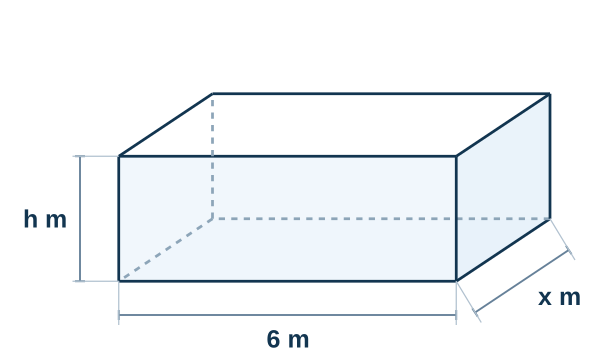
Compare costs at the turning point and both allowed limits.
The volume is
Since on the practical domain,
The base area is . The vertical side area is
Therefore the cost is
Substitute :
Thus
The units of are dollars.
Differentiate:
At a stationary point,
so
Because is a length, take the positive root:
This lies in .
To justify the global result, compare all candidates. The second derivative is
so is strictly convex on the whole allowed interval. Hence its interior stationary point is the unique global minimum, provided it is lower than the endpoints. Directly,
while
Thus the stationary point is lower than both boundary values and is the global minimum on the stated domain.
The optimal width is
The corresponding height is
The length remains (the given dimension), and the minimum cost is
Using the unrounded dimensions, . Also, the endpoint costs are $632 and $722, both above $613.428..., so rounding has not changed the winner.
The same 6 m long open-top trough must still hold , but the base rate falls to $13 per square metre and the four vertical side faces cost $15 per square metre. Keep the fabrication restriction . Construct the new one-variable cost function and determine whether the global minimum occurs at an interior stationary point or at a boundary. Give the minimum cost to the nearest cent.
With , . Then , giving , which lies in . Since , it is the global minimum; endpoint comparison confirms , , and . The height is . Therefore the minimum is about $679.91 at , an interior optimum.
SEC 3–4 · G2/G3 A MATH · QUADRATICS & CONDITIONS
For a real parameter , let
and let the line be
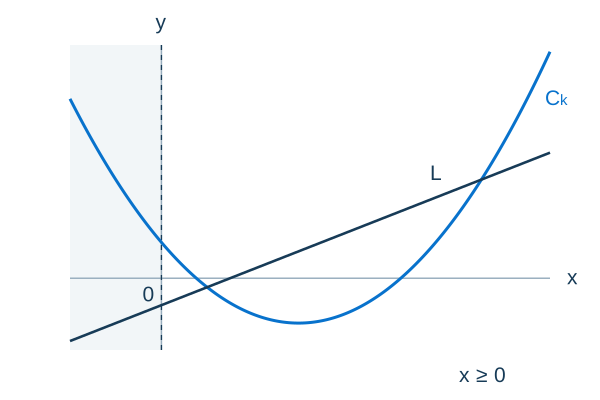
Count the intersections, then keep only those with x ≥ 0.
The coefficient of and the coefficient of are fixed. Therefore changing adds the same constant to every -value:
So is a vertical translation of one fixed upward-opening parabola. The line stays fixed.
At an intersection, the two expressions for are equal:
Rearrange as a quadratic in :
Its discriminant is
Thus:
At , the repeated root is
Then
so the tangent point is . This is the discriminant boundary.
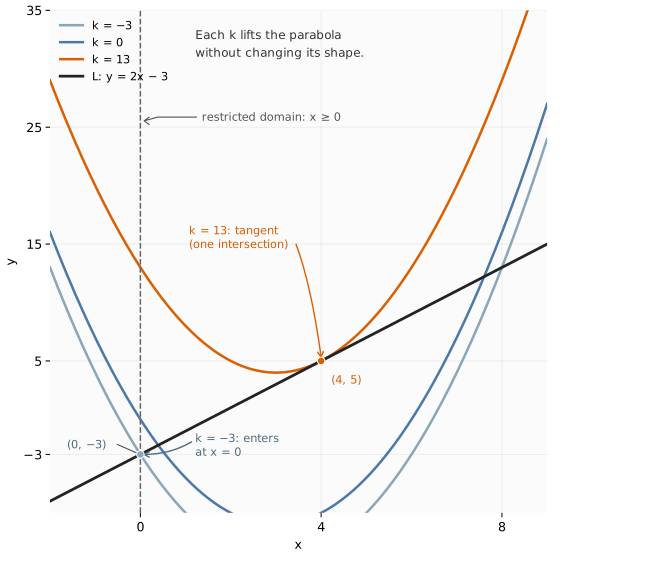 View larger graph ↗
When , the two roots are
The right-hand root is always positive. The left-hand root is allowed only when
Therefore
At , the left root is exactly , and
so the boundary point is . Because the restriction is , this point is included.
Combining the root and discriminant conditions gives the allowed classification:
| Parameter range | Number of allowed intersections | Interpretation |
|---|---|---|
| 1 | Two algebraic crossings exist, but the left one has and is excluded. | |
| 2 | Both crossings have ; at , one is exactly on the boundary. | |
| 1 | The curve is tangent to the line at . | |
| 0 | No real crossing exists even before applying the restriction. |
The coefficient of is always , so there is no degenerate linear case to add.
At the domain boundary , the line has value . Substitution into the curve gives
Therefore the curve passes through the boundary intersection exactly when , confirming the second boundary value independently.
At the tangent boundary , the curve gives
and the line gives
Both equations agree at , confirming the tangency point.
For a real parameter , consider
and the line
with the curve restricted to . Classify the number of allowed real intersections as varies, and interpret both boundary values graphically.
Equating gives , with . Real roots require , and are . The larger root is at least , so is always excluded. The smaller root satisfies precisely when , or . Hence there is one allowed intersection for and none for . At , the smaller intersection is the included boundary point ; the other is . At , the full graphs are tangent at , but this is outside , so it is not an allowed intersection. For , two real intersections exist but both are outside the permitted domain.
Two students with the same mark may need very different support. Tell us what happens when your child works independently.
Compare questions that look alike but need different methods. Name the feature that makes the choice useful.
Write one meaningful transformation per line and check each line against the one before it.
Repair the specific algebra or graph skill alongside the current A Math topic, so the new work has a firmer base.
RESEARCH-INFORMED LEARNING
Short recaps bring earlier ideas back, so your child can use them again in a new question.
Connect a diagram, the method and the reason behind it.
Try a short question from memory, then check the key idea.
Bring an earlier skill back alongside current school topics.
Choose a method, repair an error and solve a fresh version.
Key concepts return over several lessons and practice sets, with short recaps that keep earlier learning active.
Students recall a rule, explain a step or attempt a question before checking notes. This also helps locate the gap that needs attention.
A clear model leads to a partly completed question, then an independent solution as understanding becomes more secure.
Once a method is understood, mix familiar question types so students practise deciding which approach fits.
Identify the step that went wrong, correct the reasoning and return to a related question later.
Connect a calculation to a model or graph and explain why the step works.
SLC’s existing BBTP and CBC pathways give us two ways to approach the next learning goal.
Topic-by-topic work on understanding a question, choosing a strategy and solving it independently. Useful when your child needs a clearer way to begin.
Explore BBTP →Timed drills, mixed-topic practice and review of more demanding questions. Useful when your child needs to apply learning more consistently in an assessment.
Explore CBC →Discuss how topical work and exam practice can fit together around your child’s current needs.
A few useful answers before choosing a class.
Yes. The 2027 G2 Additional Mathematics syllabus K232 includes differentiation and integration. Its scope and examination format differ from G3 K341, so we plan practice for the student’s own level.
A secure foundation helps. If your child struggles with algebraic fractions, equations or graphs, share recent work so we can discuss those skills alongside A Math.
Tell us which topics are causing trouble in each subject. We can discuss how BBTP topic practice and CBC exam preparation fit the child’s priorities.
Yes. SLC’s Math lessons are online. Tell us the year level, subject and learning concern on WhatsApp to discuss a suitable class.
Choose the year and learning focus, then add context in WhatsApp.
When you message us, share your child’s recent exam results and any teacher feedback, if available.
We use the year, subject and learning context to discuss a suitable starting point and whether topical teaching, exam practice or a combination would be more useful.
Find the subject that matches your child’s school journey.
Syllabus context: SEAB 2027 SEC G3 Additional Mathematics K341 and G2 Additional Mathematics K232. Reviewed 12 November 2026.
Sources checked 12 November 2026: SEAB 2027 G2 syllabuses · SEAB 2027 G3 syllabuses