
Algebra, equations and graphs
Connect indices and standard form with quadratic equations, inequalities and function graphs. Make sense of an equation before selecting factorisation, a formula or a graphical approach.
SECONDARY 3–4 · G3 & G2 · SEC MATHEMATICS
We help Sec 3–4 learners choose and connect methods across topics, then interpret the result in context. Practice follows the student’s G2 or G3 Mathematics requirements.
Live online Math lessons · Learn from home across Singapore
FROM OUR MATH TEACHING EXPERIENCE
Our secondary Math teaching experience includes helping students improve from F9 to A1 within 3–6 months. For G2 and IP learners, we work with the school’s grading system and the child’s own targets.
Sec 3–4 builds on lower-secondary foundations. Lessons cover the student’s own G2 or G3 requirements, with attention to the topics, calculations and explanations needed for SEC Mathematics.
Connect indices and standard form with quadratic equations, inequalities and function graphs. Make sense of an equation before selecting factorisation, a formula or a graphical approach.
Use similarity, circle properties and trigonometry in longer problems. Connect coordinate geometry, sectors and solids to diagrams that make the given information clear.
Read cumulative-frequency and box-plot information, compare centre and spread, and use probability trees to keep track of combined outcomes. Interpret results in context.
For G3 learners, organise information in matrices and use vectors to describe movement and geometric relationships. These are G3 subject-content topics; G2 practice follows K210.
A CURRICULUM WITH A CLEAR STRUCTURE
Open a chapter group to see the learning focus and a short recap prompt. Earlier ideas return in later work, so the next topic has a stronger base. G3-only chapters are labelled; G2 lessons follow the relevant G2 syllabus.
Work with integer and fractional indices and express very large or small quantities clearly.
Quick recap: Check that the standard-form coefficient lies from 1 to below 10.
Choose factorisation, completing the square, a formula or a graph as appropriate.
Quick recap: Check restrictions before accepting a calculated solution.
Interpret quadratic, power and exponential graphs, gradients and the meaning of a solution interval.
Quick recap: Connect a graph feature to the algebra that produces it.
Use gradients, lengths and straight-line equations to solve geometric problems.
Quick recap: Check the gradient and a known point against the line equation.
Identify corresponding features and use circle angle or symmetry facts with clear reasons.
Quick recap: Write the geometric reason beside the key step.
Use sine and cosine rules, triangle area, bearings, elevation and depression where required.
Quick recap: Which known sides and angles determine the method?
Connect radians, arc length and sector area; calculate with composite solids.
Quick recap: Choose degrees or radians to match the formula.
Interpret cumulative-frequency diagrams and box plots; use quartiles, percentiles, range, interquartile range and standard deviation, and compare data in context.
Quick recap: Describe a comparison using both centre and spread.
Track changing outcomes, multiply along branches and add suitable mutually exclusive outcomes.
Quick recap: Does replacement change the second probability?
Use set language and Venn diagrams; organise information and calculate with matrices.
Quick recap: Check the set operation or matrix order before calculating.
Represent direction and displacement with vectors; connect length scales to area and volume scales.
Quick recap: Length scales by k, area by k² and volume by k³.
From 2027, the Singapore-Cambridge Secondary Education Certificate (SEC) replaces the former N- and O-Level certificates. G3 corresponds to the former O-Level standard; G2 corresponds to the former N(A)-Level standard.
2027 SEC Mathematics. Approved calculators are allowed in both papers at both levels. In G2 Paper 2, students answer all of Section A and choose one of two questions in Section B.
| Subject level | Papers & marks | Duration | Weighting |
|---|---|---|---|
| G3 · K310 | 2 papers · 90 marks each | 2 h 15 min each | 50% per paper |
| G2 · K210 | 2 papers · 70 marks each | 2 h each | 50% per paper |
Both G2 and G3 learners practise understanding, method selection and explanation. We adjust prerequisites, scaffolding, pace and question complexity to the student’s subject requirements and demonstrated readiness.
Make sense of the quantities, representations and conditions.
Compare possible methods and decide which fits.
Justify key steps and check the conclusion in context.
Questions follow the actual subject syllabus. Both levels include non-right-triangle trigonometry; their full scope and examination requirements differ.
| Topic / scope | G3 | G2 |
|---|---|---|
| Sets and matrices | Included | Outside K210 |
| Vectors in two dimensions | Included | Outside K210 |
| Non-right-triangle sine/cosine rules; sectors and radians | Included | Included |
All year levels below refer to 2027.
Learn current topics thoroughly, revisit the prerequisite skill when needed and practise questions that connect more than one idea.
Use marked work to choose revision priorities. Move from focused practice to timed papers, with a clear routine for working, units, accuracy and checking.
SLC WORKED EXAMPLES
Work through a composite shape, then evaluate a claim using centre and spread.
SEC 3–4 · G2/G3 · TRIGONOMETRY & MENSURATION
A triangular flowerbed has
At , an external circular sector is attached as follows. Its centre is , its radius is , and one radius lies along the ray , ending at a point on exactly from . The other radius is the ray obtained by rotating the ray away from the interior of triangle through . Thus the sector’s central angle is ; the sector and triangle share only that radius segment and do not overlap.
(a) Find , and . Choose appropriate rules and explain briefly why they apply. Keep sufficient unrounded accuracy for later parts.
(b) Find the area of triangle , the area of the external sector, and the total area of the composite flowerbed.
(c) Replace the existing sector radius by , keeping the same triangle, attachment rays and central angle. Find the new sector area and the new composite area. This replaces the old sector; do not add a second sector.
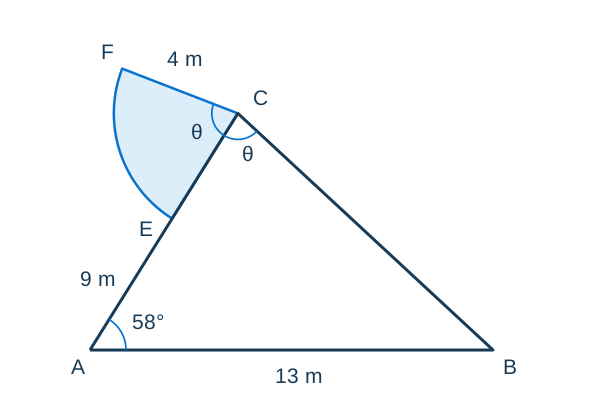
Choose and justify suitable rules.
Let , opposite .
A suitable first choice is the cosine rule because two sides and their included angle are known:
One suitable next choice is the sine rule, since is opposite and is opposite :
The inverse-sine branch is fixed by the triangle bound , together with the side order , which requires . Hence the acute principal value is the compatible value; positivity alone would not justify the choice.
Use the included-angle triangle area calculation:
The sector angle must be in radians:
Because the sector is external and non-overlapping, add the two areas once:
The triangle and are unchanged. Replace the old sector by the new one:
For an internal verification only, Heron’s formula gives the same value:
Heron’s formula is not a student prerequisite or a required method.
The radius of the external sector is now chosen so that its area equals the area of the original triangle with AB = 13 m, AC = 9 m and included angle 58°. Find this radius to 3 significant figures. The angle at C is unchanged; do not use the rounded angle from part (a).
With and radians computed from the original triangle, solve . Thus m, or 8.47 m (3 s.f.). Substituting the unrounded radius gives sector area equal to the triangle area. This radius is below CA = 9 m, so the shared boundary segment remains on CA.
SEC 3–4 · G2/G3 · STATISTICS & INTERPRETATION
Eight technicians each completed comparable support tickets using both service A and service B. Each numbered technician provided both an A and a B time; the order of services was randomised. Completion times are in minutes.
| Technician | 1 | 2 | 3 | 4 | 5 | 6 | 7 | 8 |
|---|---|---|---|---|---|---|---|---|
| Service A | 7 | 20 | 21 | 22 | 23 | 24 | 25 | 26 |
| Service B | 18 | 19 | 20 | 21 | 22 | 23 | 24 | 26 |
Lower completion time is better. The service manager will prefer a service only if its median is lower and its range is no larger than the other service. The mean should be reported as supporting evidence, not used alone.
A student claims: “Service A is better and more consistent because its mean is smaller.” Evaluate this claim using the stated decision rule and the data.

Compare the median and range using the manager’s decision rule.
For Service A:
The ordered A list is already shown. The middle values are 22 and 23:
For Service B:
The middle values are 21 and 22:
Therefore, the service manager should prefer Service B for these eight observed tasks: it has the lower median and the smaller range.
The student’s statement is incomplete and the conclusion is not supported. It is true that Service A has the smaller mean, but the 7-minute observation pulls A’s mean down. A’s median is higher and its range is wider. Also, range is not robust to outliers: because it uses only the minimum and maximum, a single unusually low or high observation can change it substantially. Thus the data support preferring B under the stated rule for these eight observed tasks, but they do not guarantee that B is better for every technician or for a wider population.
Wrong approach: “Service A has the smaller mean, so Service A is better and more consistent.”
This fails because the service manager explicitly requires the median to be lower and the range to be no larger. A’s single 7-minute result makes its mean look better, but A has both the higher median and the wider range. The range comparison is informative for this dataset but is not robust to outliers. The decision must use the stated rule, and the conclusion must remain limited to these eight observed tasks.
The eight B times run from 18 to 26, so a range of 8 is plausible; the two central B values are 21 and 22, so a median of 21.5 is consistent. The displayed summary in the teaching panel matches these recomputations.
A second group of eight technicians compares two updated services. Lower time is still better, and the same rule applies: prefer a service only if its median is lower and its range is no larger. The service manager again wants the conclusion limited to these eight observed tasks.
| Technician | 1 | 2 | 3 | 4 | 5 | 6 | 7 | 8 |
|---|---|---|---|---|---|---|---|---|
| Service C | 14 | 16 | 18 | 19 | 20 | 21 | 22 | 30 |
| Service D | 15 | 16 | 17 | 18 | 19 | 20 | 21 | 22 |
Find the mean, median and range for C and D, then state whether C or D should be preferred. Evaluate what the high C value does to the mean and range, including whether range is robust to that extreme value.
Prefer Service D: its median is lower (18.5 < 19.5) and its range is smaller (7 < 16). The 30-minute C value raises C’s mean and greatly widens C’s range. This illustrates that range is sensitive to an extreme value, not robust. The conclusion is about these eight observed tasks only.
Two students with the same mark may need very different support. Tell us what happens when your child works independently.
Locate the line where the reasoning changes, then practise that skill in a short sequence before returning to the full question.
Label what each number means. Use a diagram, variable or table to organise the information.
Build fluency with focused practice, then use mixed questions to improve method selection and checking.
RESEARCH-INFORMED LEARNING
Short recaps bring earlier ideas back, so your child can use them again in a new question.
Connect a diagram, the method and the reason behind it.
Try a short question from memory, then check the key idea.
Bring an earlier skill back alongside current school topics.
Choose a method, repair an error and solve a fresh version.
Key concepts return over several lessons and practice sets, with short recaps that keep earlier learning active.
Students recall a rule, explain a step or attempt a question before checking notes. This also helps locate the gap that needs attention.
A clear model leads to a partly completed question, then an independent solution as understanding becomes more secure.
Once a method is understood, mix familiar question types so students practise deciding which approach fits.
Identify the step that went wrong, correct the reasoning and return to a related question later.
Connect a calculation to a model or graph and explain why the step works.
SLC’s existing BBTP and CBC pathways give us two ways to approach the next learning goal.
Topic-by-topic work on understanding a question, choosing a strategy and solving it independently. Useful when your child needs a clearer way to begin.
Explore BBTP →Timed drills, mixed-topic practice and review of more demanding questions. Useful when your child needs to apply learning more consistently in an assessment.
Explore CBC →Discuss how topical work and exam practice can fit together around your child’s current needs.
Choose the subject and stage that fit your child.
From 2027, SEC replaces the former N- and O-Level certificates. G3 subjects correspond to the former O-Level standard; G2 subjects correspond to the former N(A)-Level standard. We prepare students for the subject level they take.
No. G2 Mathematics is K210 and G3 Mathematics is K310. The 2027 paper formats on this page are labelled separately, and practice follows the child’s subject requirements.
Choose our G2/G3 Lower Secondary Math pathway. It builds the algebra, graph, geometry and data skills that later SEC work uses.
Yes. E Math refers to Mathematics. A Math is the separate Additional Mathematics subject. Tell us which subject and topics need support so we can discuss the right plan.
Yes. All SLC Math lessons are online. Choose a year level and subject on this page to prepare a short WhatsApp enquiry.
Choose the year and learning focus, then add context in WhatsApp.
When you message us, share your child’s recent exam results and any teacher feedback, if available.
We use the year, subject and learning context to discuss a suitable starting point and whether topical teaching, exam practice or a combination would be more useful.
Find the subject that matches your child’s school journey.
Syllabus context: SEAB 2027 SEC G3 Mathematics K310 and G2 Mathematics K210. Reviewed 12 November 2026.
Sources checked 12 November 2026: SEAB 2027 G2 syllabuses · SEAB 2027 G3 syllabuses