
Algebra & functions
Move between expressions, equations and graphs. Explain the relationships instead of relying on a remembered sequence.
YEARS 1–4 · SCHOOL-ADAPTED · ONLINE
We help IP learners recognise structure in unfamiliar questions, connect ideas and build mathematical arguments. We plan from the student’s school topics, recent work and current understanding.
Live online Math lessons · Learn from home across Singapore
FROM OUR MATH TEACHING EXPERIENCE
Our secondary Math teaching experience includes helping students improve from F9 to A1 within 3–6 months. For G2 and IP learners, we work with the school’s grading system and the child’s own targets.
There is no single national IP Math syllabus for every school. Published RI and RGS curricula emphasise understanding, independent thinking and application. The useful starting point is your child’s own school sequence.
Move between expressions, equations and graphs. Explain the relationships instead of relying on a remembered sequence.
Read the diagram carefully, identify useful properties and build a chain of reasons that supports the solution.
Interpret information and test conclusions. For later-year work, discuss the calculus and other topics on the school’s current plan.
A CURRICULUM WITH A CLEAR STRUCTURE
Open a chapter group to see the learning focus and a short recap prompt. Earlier ideas return in later work, so the next topic has a stronger base. SLC’s year map is illustrative and school-dependent. We adapt the sequence, depth and practice to your child’s school topics and assessment needs.
Connect factors, real numbers, estimation, ratio, rates and percentages.
Quick recap: Estimate first and explain the unit used.
Use expressions, equations, simultaneous linear relationships, graphs and sequences.
Quick recap: Explain how a rule appears in both a formula and a graph.
Build angle, polygon, area, volume and data-reading skills with clear explanations.
Quick recap: Which property makes the calculation valid?
Connect factorisation, equations, graphs, algebraic fractions and indices.
Quick recap: Match roots and turning points to the graph.
Connect Pythagoras, similarity, triangle trigonometry, circle properties, sectors and radian measures as the school sequence develops.
Quick recap: Read the diagram before deciding on a rule.
Use set or outcome representations and compare statistical displays and measures.
Quick recap: Explain what the data supports, using its context.
Develop work with polynomials, surds, logarithms, graph transformations and coordinate geometry.
Quick recap: Check the domain before accepting a solution.
Link circle equations, plane-geometry reasoning, matrices and linearised relationships.
Quick recap: Explain why the chosen representation helps.
Connect graphs, special angles, identities, compound angles and equivalent trigonometric forms.
Quick recap: Track every solution in the required interval.
Use expansion structure and probability representations in multi-step reasoning.
Quick recap: State the conditions before using a formula.
Connect derivatives and integrals to graphs, optimisation, area, rates and motion, including the school’s required function types.
Quick recap: What physical or geometric quantity does the answer represent?
Use vector relationships and revisit earlier algebra, geometry and trigonometry in longer solutions.
Quick recap: Compare two methods and explain which is more efficient.
These illustrative priorities guide SLC’s IP teaching. We adapt the starting point and pace to your child’s school topics and recent work.
Connect number skills with expressions, linear equations and straight-line graphs. Use clear diagrams and explanations for geometry, measurement and introductory statistics.
Link quadratic equations to their graphs, work confidently with algebraic fractions and extend geometry through similarity and trigonometry. Build meaning behind each method before adding speed.
Deepen algebra through polynomials, surds and logarithms. Read function transformations, develop coordinate-geometry reasoning and connect trigonometric graphs, equations and identities.
Consolidate trigonometry alongside calculus, probability and vectors. Practise choosing methods across topics, showing a complete argument and checking a solution against its conditions.
SLC WORKED EXAMPLES
Two SLC IP examples connect geometric proof, trigonometry and calculus with clear reasons at each step.
SLC IP Y2–Y3 · SIMILARITY & PROOF
In trapezium , , and . The diagonals and meet at .
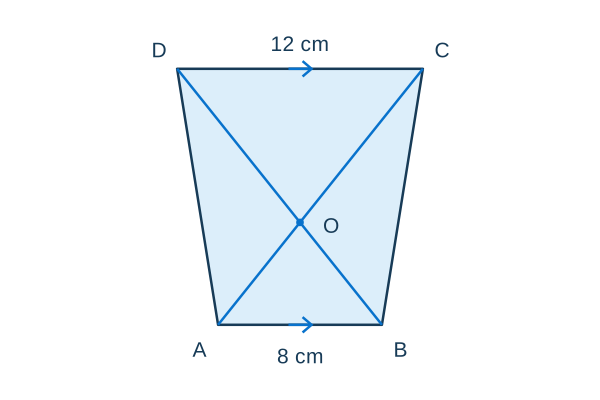
Similarity → ratios → areas
Because ,
Also, because they are vertically opposite. Therefore
Corresponding sides are proportional:
Thus
Triangles and use bases and on the same line , and have the same altitude from . Hence
Triangles and use bases and on the same line , and have the same altitude from . Hence
Both areas are therefore , so
This equality follows from two common-altitude/base ratios, not from the drawing's appearance.
For , use both corresponding-side ratios, or multiply the two area factors:
Therefore
In the exact coordinate model , , , , , direct determinant areas are , , , cm². Their sum is cm², matching .
In trapezium , , , , and diagonals meet at . If , prove the corresponding diagonal ratio and find , , and .
The same AA argument gives . The common-altitude/base ratios give
so . Finally
so . This is independently recomputed from the follow-up values, not copied from the main answer.
SLC IP Y4 · TRIGONOMETRY & CALCULUS
A rectangular panel is placed in the corner of a quarter-circle. One vertex is at the centre O of the quarter-circle, two adjacent sides lie along the perpendicular radii, and the opposite vertex P lies on the arc. The radius is 12 m. Let be the angle between and the horizontal radius.
The mechanism permits only
Using the geometry, construct a trigonometric model for the panel's area . Then find the maximum possible area.
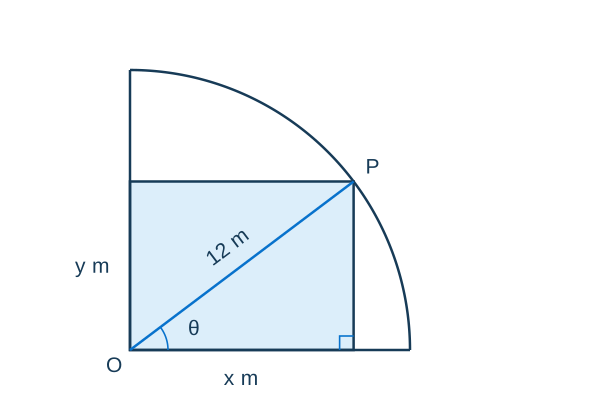
CONSTRUCTION → TEST
Let the rectangle's width be and height be . The radius triangle gives
Therefore
Differentiate with respect to (in radians):
For a stationary point,
Within , the only solution is
Now test the stationary point and both endpoints:
Since and , the maximum is
at
at , , so , agreeing with the model.
A similar panel has radius m and the mechanism permits . Construct the area model, check whether any stationary point is admissible, test both endpoints, and state the maximum area exactly.
, with derivative . The stationary solution is outside the permitted interval and must be rejected. At the endpoints, and . Thus the maximum is at . Alternatively, lies between and , where cosine is negative, so the area decreases throughout the interval. This tests why the unrestricted square solution is not always admissible.
Two students with the same mark may need very different support. Tell us what happens when your child works independently.
Compare a familiar question with a changed version. Identify what stays the same and what needs a new idea.
Slow down at the key reasoning step and make the argument clear enough for another person to follow.
Choose the prerequisite concept that will make the next school topic easier to approach.
RESEARCH-INFORMED LEARNING
Short recaps bring earlier ideas back, so your child can use them again in a new question.
Connect a diagram, the method and the reason behind it.
Try a short question from memory, then check the key idea.
Bring an earlier skill back alongside current school topics.
Choose a method, repair an error and solve a fresh version.
Key concepts return over several lessons and practice sets, with short recaps that keep earlier learning active.
Students recall a rule, explain a step or attempt a question before checking notes. This also helps locate the gap that needs attention.
A clear model leads to a partly completed question, then an independent solution as understanding becomes more secure.
Once a method is understood, mix familiar question types so students practise deciding which approach fits.
Identify the step that went wrong, correct the reasoning and return to a related question later.
Connect a calculation to a model or graph and explain why the step works.
SLC’s existing BBTP and CBC pathways give us two ways to approach the next learning goal.
Topic-by-topic work on understanding a question, choosing a strategy and solving it independently. Useful when your child needs a clearer way to begin.
Explore BBTP →Timed drills, mixed-topic practice and review of more demanding questions. Useful when your child needs to apply learning more consistently in an assessment.
Explore CBC →Discuss how topical work and exam practice can fit together around your child’s current needs.
A few useful answers before choosing a class.
No. Schools set their own sequences and assessment tasks. Share the school, year and current topics so we can discuss suitable support.
There is overlap, but useful IP support also develops explanations, connections and flexible thinking around the school’s work. We plan from that work rather than applying one exam template to everyone.
Yes. Ask about a transition plan that connects primary problem solving to algebra, notation and explaining a method. Tell us the school and that your child will enter Y1 in 2027.
Yes. SLC’s Math lessons are online. Tell us the year level, subject and learning concern on WhatsApp to discuss a suitable class.
Choose the year and learning focus, then add context in WhatsApp.
When you message us, share your child’s recent exam results and any teacher feedback, if available.
We use the year, subject and learning context to discuss a suitable starting point and whether topical teaching, exam practice or a combination would be more useful.
Find the subject that matches your child’s school journey.
Learning focus reviewed 12 November 2026. We use your child’s school topics and recent work to plan the next step.
Sources checked 12 November 2026: RI Mathematics curriculum · RGS Mathematics curriculum