
Numbers & relationships
Connect fractions, decimals, percentages and ratio. Ask what each quantity represents before choosing an operation.
PRIMARY 4–6 · PSLE PREPARATION · ONLINE
We help P4–P6 learners make sense of word problems, represent quantities with models and diagrams, and explain why their solution works.
Live online Math lessons · Learn from home across Singapore
FROM OUR MATH TEACHING EXPERIENCE
We have experience helping PSLE Math students improve from AL6 to AL1 within 3–6 months. We start with the mistakes in recent work, then focus lessons and practice on what the child needs next.
The revised PSLE Mathematics format applies from 2026. It assesses basic skills, application and reasoning. This page covers Standard Mathematics (0008); Foundation Mathematics (0038) has a separate syllabus and format. We use the MOE primary curriculum to connect topic understanding with the demands of both papers.
Connect fractions, decimals, percentages and ratio. Ask what each quantity represents before choosing an operation.
Use clear diagrams for angles, area and volume. Label units and check whether an answer is sensible.
Read tables and graphs carefully. Organise the given information and keep a longer solution easy to follow.
A CURRICULUM WITH A CLEAR STRUCTURE
Open a chapter group to see the learning focus and a short recap prompt. Earlier ideas return in later work, so the next topic has a stronger base.
Place value, rounding and written operations; find useful factor and multiple relationships.
Quick recap: Estimate first. Does the calculated answer fit?
Connect mixed numbers, improper fractions and fractions of a set; add and subtract unlike fractions.
Quick recap: What does the denominator tell you about equal parts?
Read and compare decimal places, connect fractions to decimals and calculate with simple decimal quantities.
Quick recap: Check the place value and unit before calculating.
Find missing rectangle or square dimensions and split a composite figure into familiar parts.
Quick recap: Trace the outside boundary for perimeter.
Measure and name angles; use rectangle and square properties, complete symmetric figures and connect solids to nets.
Quick recap: Which faces meet when the net folds?
Complete tables and read information from different displays before drawing a conclusion.
Quick recap: Read the labels and scale before using a number.
Work with larger numbers, powers of ten, brackets and the correct order of operations.
Quick recap: Which operation comes first, and why?
Connect division to fractions; calculate with mixed numbers and fraction products.
Quick recap: Represent the fraction of a fraction with a model.
Multiply and divide by powers of ten, and convert length, mass and capacity measures.
Quick recap: Is the new numerical value larger or smaller?
Find a percentage of a quantity and apply it to discounts, GST or interest; relate rate, total and number of units.
Quick recap: Identify the whole and write the rate with its unit.
Use perpendicular height for triangle area, angle relationships and the properties of special quadrilaterals.
Quick recap: Does the chosen height meet the base at 90°?
Build volume from unit cubes, use length × width × height, and connect cm³ with ml and litres.
Quick recap: Volume = base area × vertical height.
Interpret dividing by a fraction and carry out the required non-calculator operations.
Quick recap: How many equal groups fit into the given amount?
Recover a whole from a part and percentage; work with percentage increase and decrease.
Quick recap: Which quantity represents 100% in this question?
Simplify and compare ratios, divide a quantity in a ratio and connect fraction and ratio representations.
Quick recap: Count the equal units before dividing the total.
Use a letter for an unknown, simplify expressions, substitute values and solve simple equations.
Quick recap: What does the letter represent in the story?
Connect radius and diameter to area and circumference; separate straight and curved boundaries.
Quick recap: For a semicircle perimeter, include the diameter.
Find a missing cuboid dimension from its volume and other dimensions, or a cube’s edge from its volume, using suitable numbers and calculator skills.
Quick recap: Keep area units and volume units distinct.
Connect triangle and special-quadrilateral properties to find unknown angles in a larger figure.
Quick recap: Name the property that justifies each angle step.
Move between the average, the total and how many values are included.
Quick recap: Total = average × number of values.
Mathematics 0008 · format for examinations from 2026 · total 100 marks. Paper 1 needs fluent calculation; Paper 2 also calls for clear, sustained problem solving.
| Paper | Marks | Duration | What to prepare for |
|---|---|---|---|
| Paper 1 | 50 | 1 h 10 min | 18 multiple-choice + 12 short-answer; no calculator |
| Paper 2 | 50 | 1 h 20 min | 5 short-answer + 10 structured / long-answer; calculator allowed |
Choose the year level in 2027, then tell us what feels difficult in current schoolwork.
Build the habits that make later word problems easier: represent, explain and check.
Connect upper-primary topics and learn to choose between useful strategies independently.
Prioritise recurring gaps, practise both papers and build a practical routine for time and checking.
SLC WORKED EXAMPLES
See how a diagram or an unchanged quantity can reveal the next step.
P4 · AREA & PERIMETER
The figure below is made up of rectangles. AB is 27 cm long and the total height of the figure is 23 cm. The lengths BC, CD, EF, GH and HA are equal.
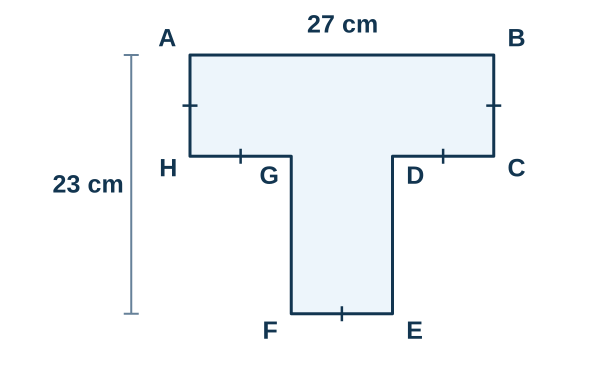
Use the equal sides to find the missing lengths, then split the shape for area and trace its boundary for perimeter.
The three horizontal lengths HG, FE and DC together make up the full width AB. Since they are equal:
27 ÷ 3 = 9 cm
The matching marks show that AH and BC are also 9 cm.
The two longer vertical sides, GF and DE, are therefore:
23 − 9 = 14 cm
Draw a horizontal line from G to D to split the figure into two rectangles.
Area of the figure
= 243 + 126
= 369 cm²
Trace the boundary from A to B, C, D, E, F, G, H and back to A.
Perimeter
= 27 + 9 + 9 + 14 + 9 + 14 + 9 + 9
= 100 cm
A second T-shaped sign has a top width of 36 cm, a total height of 30 cm, and the same construction: the stem sides divide the top width into three equal widths, and the five one-stroke sides are equal. Find its area and perimeter.
The equal width is 36 ÷ 3 = 12 cm, so the top bar is 36 × 12 and the stem is 12 × (30 − 12) = 12 × 18. Therefore area = 432 + 216 = 648 cm². The boundary lengths are 36, 12, 12, 18, 12, 18, 12, 12, so perimeter = 132 cm. This is a valid simple T-shape because the stem width is 12 cm, less than the top width 36 cm, and the stem height is positive 18 cm.
P5 · FRACTIONS OF A REMAINDER
There was some juice in a container. First, of the juice was poured out. Then, of the remaining juice was poured out.
The amount poured out the first time was 18 litres less than the amount poured out the second time.
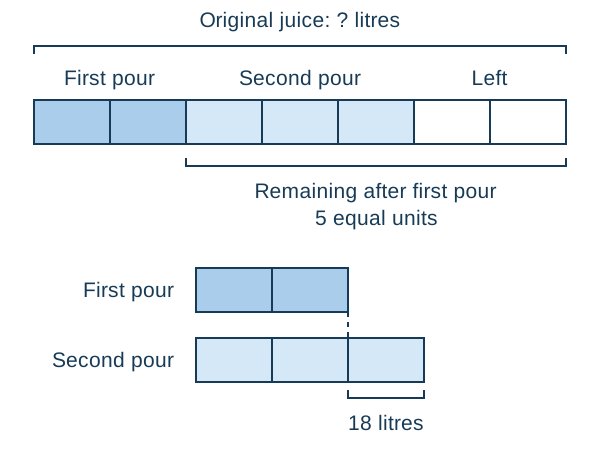
The second fraction refers to the juice remaining after the first pour, not the original amount.
Represent the original amount of juice by 7 equal units.
The second pour was 18 litres more than the first pour.
Difference between the pours
= 3 units − 2 units
= 1 unit
Therefore, 1 unit represents 18 litres.
After the second pour, the amount left was:
5 units − 3 units = 2 units
Juice left
= 2 × 18
= 36 litres
The original amount was 7 units.
Original amount
= 7 × 18
= 126 litres
The first pour was 36 litres, leaving 90 litres. The second pour was 54 litres—18 litres more than the first—and 36 litres remained.
A tank held an unknown amount of water. First, was used. Then, of the remainder was used. The first amount used was 15 L more than the second. Find the original amount and the amount left, using equal-unit reasoning without fraction division.
Represent the original by 8 units. First use = 3 units; remainder = 5 units; second use = 2 units. The difference is 1 unit = 15 L. Original = 8 × 15 = 120 L; left = 3 × 15 = 45 L. Check: first use 45 L, remainder 75 L, second use 30 L, difference 15 L, left 45 L.
P6 · CHANGING RATIO
At first, the ratio of the number of boys to the number of girls in a school sports club was 3 : 2.
After 24 boys joined the club, the ratio of the number of boys to the number of girls became 5 : 3. No girls joined or left the club.
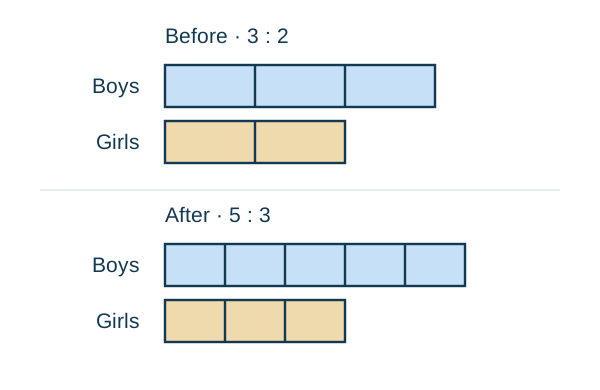
The number of girls stayed unchanged, so match the girls’ parts before comparing the two ratios.
Before: boys : girls = 3 : 2
After: boys : girls = 5 : 3
Rewrite both ratios so that the girls have 6 parts:
The girls’ 6 parts represent the same number of girls in both situations. On this common scale, the boys increased from 9 parts to 10 parts.
Increase in boys
= 10 parts − 9 parts
= 1 part
Since 24 boys joined, 1 part represents 24 members.
Original number of boys
= 9 × 24
= 216 boys
Original number of girls
= 6 × 24
= 144 girls
New number of boys
= 216 + 24
= 240 boys
The number of girls remained 144.
New total membership
= 240 + 144
= 384 members
Use the new total membership, because the question asks for the percentage after the boys joined.
Percentage of boys
= 240 ÷ 384 × 100%
= 62.5%
The original ratio 216 : 144 simplifies to 3 : 2. The new ratio 240 : 144 simplifies to 5 : 3, while the number of girls remains unchanged.
At another club, the ratio of boys to girls was . Then 21 boys joined, while the number of girls stayed unchanged. The new ratio was . Find the original and new numbers, then find the new percentage of boys to 1 decimal place. Explain which common girls scale you used.
Match the girls parts with 6: before , after . The one extra boys' part is 21, so one part is 21. Original numbers are 168 boys and 126 girls; new numbers are 189 boys and 126 girls. The new total is 315, so the boys' percentage is . The invariant is the 6-part girls bar, and the added boys are the one-part difference.
Two students with the same mark may need very different support. Tell us what happens when your child works independently.
Practise identifying the known quantities and the unknown. Choose a diagram or table that makes their relationship visible.
Separate the calculation from the word problem briefly, then put the improved skill back into a full solution.
Strengthen familiar methods first. Add timed mixed practice when the child can explain the method independently.
RESEARCH-INFORMED LEARNING
Short recaps bring earlier ideas back, so your child can use them again in a new question.
Connect a diagram, the method and the reason behind it.
Try a short question from memory, then check the key idea.
Bring an earlier skill back alongside current school topics.
Choose a method, repair an error and solve a fresh version.
Key concepts return over several lessons and practice sets, with short recaps that keep earlier learning active.
Students recall a rule, explain a step or attempt a question before checking notes. This also helps locate the gap that needs attention.
A clear model leads to a partly completed question, then an independent solution as understanding becomes more secure.
Once a method is understood, mix familiar question types so students practise deciding which approach fits.
Identify the step that went wrong, correct the reasoning and return to a related question later.
Connect a calculation to a model or graph and explain why the step works.
SLC’s existing BBTP and CBC pathways give us two ways to approach the next learning goal.
Topic-by-topic work on understanding a question, choosing a strategy and solving it independently. Useful when your child needs a clearer way to begin.
Explore BBTP →Timed drills, mixed-topic practice and review of more demanding questions. Useful when your child needs to apply learning more consistently in an assessment.
Explore CBC →Discuss how topical work and exam practice can fit together around your child’s current needs.
A few useful answers before choosing a class.
It can. P4 is a useful time to strengthen understanding and problem-solving habits. P5 can connect those habits to upper-primary topics. The starting point should reflect what your child can already do independently.
It helps with calculation, but the child still needs to interpret the question, choose a strategy and show the solution. Practice should develop those decisions as well as calculator use.
Start with age-appropriate primary Math foundations rather than a PSLE paper. Explore our Primary Math page, or tell us the year level and the skill your child finds difficult.
Yes. Our secondary-school cut-off guide brings together past scores, school filters, an AL planner and a six-choice shortlist. It also helps parents plan the move into Secondary 1.
Yes. SLC’s Math lessons are online. Tell us the year level, subject and learning concern on WhatsApp to discuss a suitable class.
Choose the year and learning focus, then add context in WhatsApp.
When you message us, share your child’s recent exam results and any teacher feedback, if available.
We use the year, subject and learning context to discuss a suitable starting point and whether topical teaching, exam practice or a combination would be more useful.
Find the subject that matches your child’s school journey.
P1–P3? Explore primary Math foundations →Plan secondary-school choices with our PSLE guide →
Syllabus context: MOE 2021 Primary Mathematics syllabus and SEAB Mathematics 0008 examination format from 2026. Reviewed 12 November 2026.
Sources checked 12 November 2026: MOE primary syllabus (updated Oct 2025) · SEAB PSLE Mathematics 0008, from 2026