
Recognises a word only in a list
A familiar character looks unfamiliar inside a passage.
Teaching focus
Revisit meaning through a short context, related phrases and a new sentence the child can explain.
Build confident Chinese learning in Primary 4, with support matched to your child’s needs.
Every learner starts from a different place. We begin by understanding your child's needs, then discuss the level, format and learning support that best fits their next step.
Marymount centre + online options
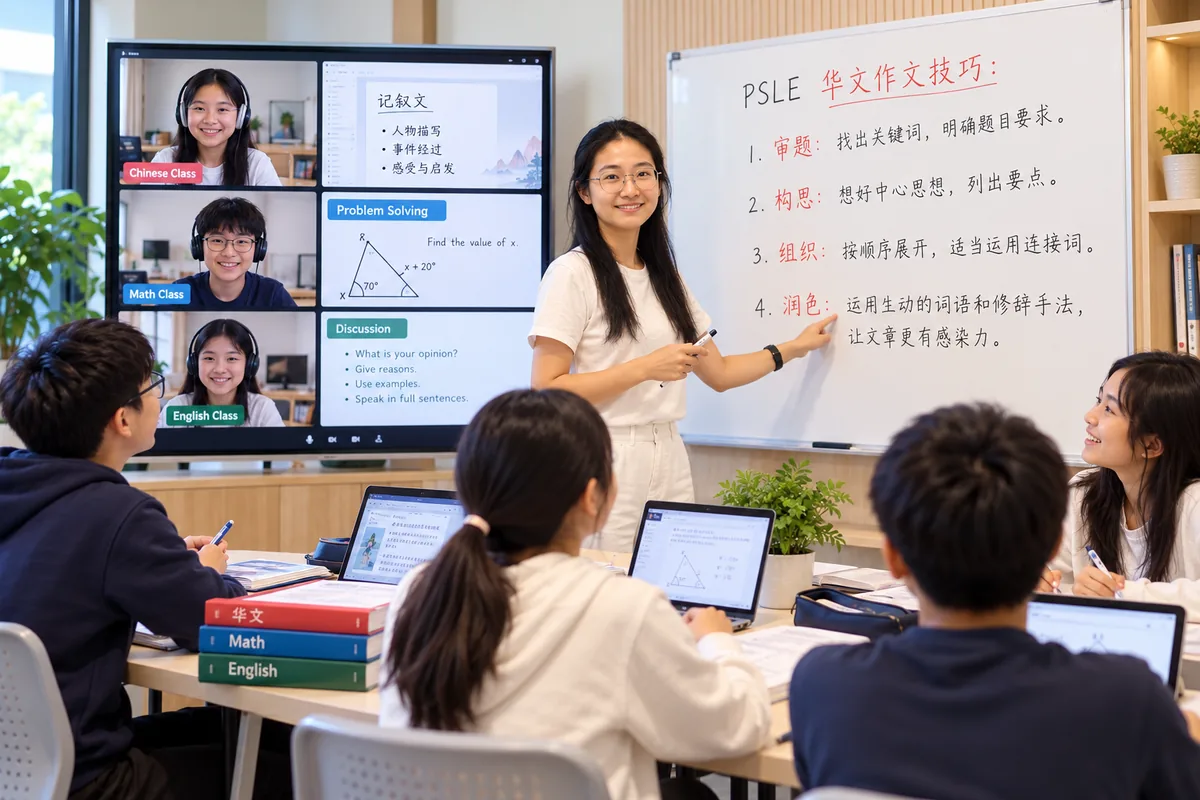
A child who succeeds with prompting may still be unsure how to begin alone. We focus on reading the question, choosing evidence and revising a short response independently. The goal is reliable understanding rather than dependence on a template.
At this age, steady progress matters most: reading with understanding, using new words naturally and explaining an idea clearly. We build these habits now so your child has a stronger foundation for the upper-primary years.
Spelling success does not always transfer to comprehension or composition. A learner may recognise a word in a familiar list but lose its meaning in a new sentence. We distinguish recognition gaps, weak sentence understanding and difficulty expressing an idea, rather than treating every lost mark as a need for more memorisation.
| Component | Weight / marks | Format |
|---|---|---|
| Writing | 20% | 50 min; topic or picture composition |
| Language use & comprehension | 45% | 1 h 40 min |
| Oral | 25% | Reading aloud and video-based conversation |
| Listening · Home practice; not taught at SLC | 10% | About 30 min |
Official syllabus references:PSLE Chinese 0005
A familiar character looks unfamiliar inside a passage.
Revisit meaning through a short context, related phrases and a new sentence the child can explain.
The child has located the event but not identified what the question asks.
Separate who, what, why and how; select evidence and shape it into a precise response.
A story becomes a list of actions with little connection between events.
Use oral rehearsal, a simple event sequence and sentence expansion before independent writing.
Talk about a short everyday event in Mandarin. Invite your child to say what happened, why it mattered and how someone felt. This gives written work an accessible starting point.
Higher Chinese readiness is not simply finishing standard Chinese exercises faster. A learner needs to handle ambiguity, recognise why a word or sentence is wrong and draw together meaning across a passage. We look for depth of understanding as well as accuracy.
| Component | Weight / marks | Format |
|---|---|---|
| Writing | 40% | 50 min; choose a topic composition or complete a story; more than 200 Chinese characters |
| Language use & comprehension | 60% | 1 h 20 min; cloze, character/word correction and two open-response comprehension sections |
This Higher Chinese examination has no separate oral or listening paper. It should not be confused with the standard Chinese assessment or the secondary Higher Chinese oral examination.
Official syllabus references:PSLE Higher Chinese 0015
Retelling events can conceal difficulty seeing the idea that connects them.
Compare key events and character choices, then explain how they support an overall interpretation.
A replacement sounds plausible but does not fit the sentence meaning.
Explain the original error and test the replacement against context and word combinations.
The continuation changes the character’s motivation or ignores the given opening.
Track the original situation, preserve logical links and develop a purposeful ending.
After a story, ask your child to explain its central idea and justify it with two moments from the text. Listen for reasoning rather than a memorised moral.
Bring a recent marked assignment, your child’s level and any teacher feedback to the programme discussion. We can use these to identify whether the priority is understanding, expression, application or independent working.
Look for a repeated error pattern and ask the learner to explain a response. One low score alone does not show the cause.
CBC offers structured coaching; BBTP offers targeted practice. Discuss the appropriate subject and components before choosing the combination.
Useful review questions include: can the child explain the method, revise the answer and apply the learning to a fresh task with less prompting?
Try the questions above with your child. Their explanation often tells you more than the final answer and helps us decide what to work on next.
Share the level, subject and areas that need attention.
Our team will advise on support and assessment where appropriate.
Ask us about lesson times, online or Marymount options, and fees.
Start with your child’s stage, subject and learning needs. Our Academic Strategist can discuss a suitable pathway and whether a profile banding assessment would help.
English and Chinese learning can take place at the Marymount centre or online, subject to programme availability. Math is offered online. Please confirm your preferred format with our team.
Class placement and available times depend on your child’s learning needs. Contact our team with your preferred days and times for current availability and fees.
Our Academic Strategist will first discuss your child’s learning with you online, answer your questions and help you choose a suitable class.
Tell us your child's level, subject and learning needs. Our team will guide you.