
English
Example mark: 87
Understand the AL bands, add the four subject scores and see what to work on next. Clear explanations from SLC’s academic team, informed by our experience teaching in Singapore schools.
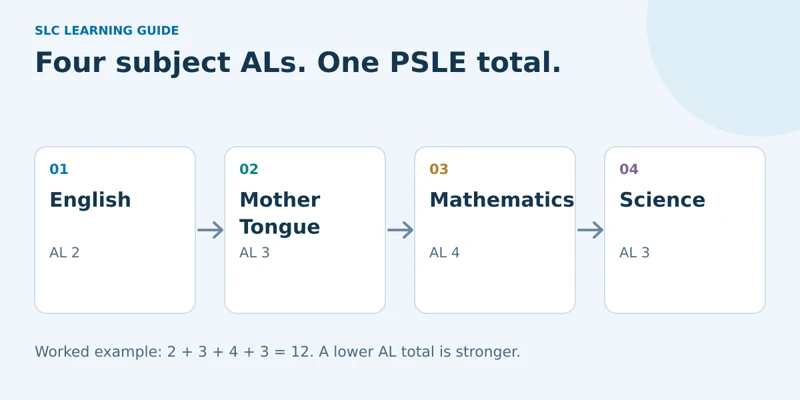
The AL system has been in use since 2021. This guide helps families plan for PSLE in 2027–2028.
For a Standard-level subject, marks are grouped into eight Achievement Levels (ALs). AL 1 is the strongest result. The same bands apply to English, Mother Tongue, Mathematics and Science.
| Achievement Level | Subject mark |
|---|---|
| AL 1 | 90–100 |
| AL 2 | 85–89 |
| AL 3 | 80–84 |
| AL 4 | 75–79 |
| AL 5 | 65–74 |
| AL 6 | 45–64 |
| AL 7 | 20–44 |
| AL 8 | Below 20 |
The PSLE total adds ALs, rather than averaging the four marks. A lower total is stronger. The possible totals run from 4 to 32.
Add the four subject ALs. Here is a worked example:
Example mark: 87
Example mark: 82
Example mark: 78
Example mark: 81
2 + 3 + 4 + 3 = a PSLE total of 12.
If Mathematics improves from 78 to 80, it moves from AL 4 to AL 3. With the other subjects unchanged, the total improves from 12 to 11.
Foundation subjects use grades A, B and C. For the PSLE total used in Secondary 1 posting, these map to Standard-level AL equivalents.
| Foundation grade | Mark | Points in the total |
|---|---|---|
| A | 75–100 | 6 |
| B | 30–74 | 7 |
| C | Below 30 | 8 |
A Foundation A therefore contributes 6 points to the total. It does not count as AL 1.
Higher Chinese is separate from the four-subject total. Your child’s Mother Tongue AL still counts in that total.
For Special Assistance Plan (SAP) schools, students with the same PSLE total can receive a posting advantage based on Higher Chinese grades: Distinction, then Merit, then Pass. This happens before the usual posting tie-breakers. Higher Chinese does not give bonus points that you subtract from the AL total.
Posting Groups are used for Secondary 1 admission. They are different from the G1, G2 and G3 levels at which individual subjects are taught under Full Subject-Based Banding.
| PSLE total | Posting Group eligibility |
|---|---|
| 4–20 | Posting Group 3 |
| 21–22 | Posting Group 2 or 3 |
| 23–24 | Posting Group 2 |
| 25 | Posting Group 1 or 2 |
| 26–30, with AL 7 or better in English and Mathematics | Posting Group 1 |
Under Full SBB, a child can take different subjects at different levels according to their strengths. The overall total does not tell you everything about their readiness for Chinese, English or Math.
The usual tie-breakers are applied in this order:
Compare secondary-school cut-offs and build your six choices →
In our work with families, we start with the marked paper and ask the child to explain an answer. That helps us see whether the difficulty is vocabulary, understanding the question, organising ideas or applying a method independently.
For example, 65 and 74 are both AL 5. A child at 74 may be close to the next boundary. A child at 65 may first need to make the foundation more dependable. Both need a plan based on their work.
SLC’s curriculum development is supported by experienced academic advisors. Mrs Ong Yee Hwa is a retired Head of Department and Senior Teacher with over 30 years of experience across classroom teaching, curriculum development and teacher training. Her background spans English, Mathematics and Science.
Meet SLC’s academic advisors →A prelim result is a checkpoint. The paper, preparation and performance on the day can differ from PSLE. Use the result to decide what to teach next.
Add the Achievement Levels for English, Mother Tongue, Mathematics and Science. The total ranges from 4 to 32. A lower total is stronger.
No. Higher Chinese is graded separately. It does not add a fifth AL to the four-subject total. Its grade can give a posting advantage for SAP schools when students have the same PSLE score.
Yes. A Standard subject mark of 65 and a mark of 74 both fall in AL 5. The AL changes when the mark crosses the next band boundary.
No. A cut-off describes the last student admitted through a particular route in a previous posting exercise. The next cut-off depends on applicants and places.
Review the subject marks and the actual mistakes. Choose a small number of skills to improve, then use the next piece of work to check whether the child can apply what they learned.
Tell our Academic Strategist your child’s level, recent subject marks and main difficulty. We’ll help you decide where English, Chinese or Math support would make the most difference.
WhatsApp our Academic Strategist →