
Knows the words, misses the meaning
An answer repeats a sentence without explaining what it implies.
How we help
Locate evidence, explain the link to the question, then check whether the answer fully responds.
A clear plan for the final stretch of primary school.
Tell us what happens when your child does their schoolwork. Do they struggle to understand the question, get started or explain an answer? A recent assignment can help us discuss which class would be useful.
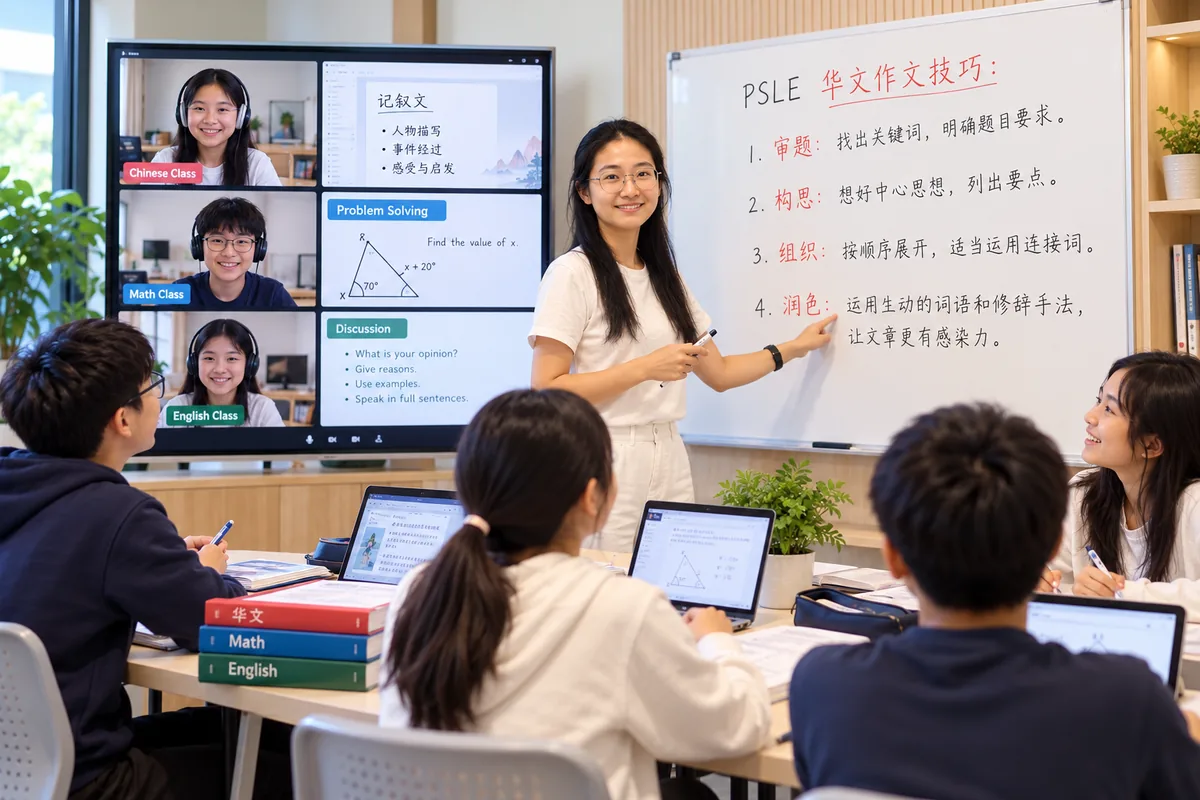
Marymount centre + online options
Speaking English comfortably does not always mean doing well in English exams. Your child may miss the meaning behind a sentence, go off-topic in composition or leave out part of a situational-writing task. We look at their answers to decide what needs practice.
| Component | Weight / marks | Format |
|---|---|---|
| Writing | 25% | 1 h 10 min; situational 14 marks, continuous 36 marks |
| Language use & comprehension | 45% | 1 h 50 min |
| Listening · Home practice; not taught at SLC | 10% | About 35 min |
| Oral communication | 20% | Reading aloud and photo-based conversation |
Official syllabus references:PSLE English 0001
An answer repeats a sentence without explaining what it implies.
Locate evidence, explain the link to the question, then check whether the answer fully responds.
Interesting language cannot rescue a story that drifts away from the topic.
Plan the central event and turning point, then revise for relevance, paragraph flow and sentence accuracy.
A child gives a view but cannot develop it beyond one sentence.
Practise an opinion, a reason and a relevant personal example, followed by a natural response to a follow-up question.
Ask “Which part of the text made you think that?” rather than only checking whether the answer is right. Progress includes clearer explanations and better revisions, not just longer answers.
Does your child do well in 听写 but struggle with comprehension or composition? They may recognise a word on the spelling list without knowing what it means in a passage. We check whether they need help recognising characters, understanding sentences or putting their own ideas into words.
| Component | Weight / marks | Format |
|---|---|---|
| Writing | 20% | 50 min; topic or picture composition |
| Language use & comprehension | 45% | 1 h 40 min |
| Oral | 25% | Reading aloud and video-based conversation |
| Listening · Home practice; not taught at SLC | 10% | About 30 min |
Official syllabus references:PSLE Chinese 0005
A familiar character looks unfamiliar inside a passage.
Revisit meaning through a short context, related phrases and a new sentence the child can explain.
The child has located the event but not identified what the question asks.
Separate who, what, why and how; select evidence and shape it into a precise response.
A story becomes a list of actions with little connection between events.
Use oral rehearsal, a simple event sequence and sentence expansion before independent writing.
Talk about a short everyday event in Mandarin. Invite your child to say what happened, why it mattered and how someone felt. This gives written work an accessible starting point.
Share a recent marked assignment and any comments from the school teacher. We’ll look at where your child gets stuck and discuss what to work on first.
Does the same mistake keep coming up? Ask your child how they got the answer. The score alone may not tell you what went wrong.
CBC is for regular subject teaching. BBTP gives extra practice in a particular skill, such as writing or problem-solving. We can discuss whether your child needs one or both.
Can your child explain the answer, correct a mistake and try a similar question with less help? These are useful things to check alongside school marks.
Ask your child to talk you through an answer. Hearing their explanation can help you see which part they understand and where they need help.
Tell us your child’s level, subject and what they find difficult.
We’ll discuss suitable classes and let you know if an assessment would help.
Check the class time, fees and whether lessons are online or at Marymount.
Tell us your child’s level, subject and what they find difficult. Our team will explain the class options and whether an assessment would help us recommend a class.
English and Chinese learning can take place at the Marymount centre or online, subject to programme availability. Math is offered online. Please confirm your preferred format with our team.
Tell us your child’s level and the days you’re free. We’ll check suitable classes, available times and the fee with you.
We’ll first speak with you online about your child’s schoolwork, answer your questions and discuss a suitable class.
Tell us your child’s level, subject and what they need help with. We’ll talk you through the class options.